Tuesday, July 30, 2013

Interns@SmartGrid_group

Today we report of a short interview we had with two of our interns, who have been working for one month on developing a web-based home energy management system, consisting in an Android application and a web service.


What's your name? 
Matthias

What are you studying?
I have been studying electronics and technical informatics a the HTL Mössingerstraße in Klagenfurt. This year I finished the 2nd class. 

What are your expectations for the future?
After the HTL I want to study software/game development and found a software company.

What your working on?
I worked on two different versions of the same Android app, as well as a REST webservice implemented in PHP.
Basically, I have designed and implemented a MySQL database, and used the php webservice to handle the data and expose the functionalities to the android app I then developed. The apps differ for the JSON protocol used. In fact, only one of these apps is using the php webservice I implemented, the other one is a solution we prepared to mantain retro-compatibility with the old version of the app that was already working for an older project and running on the Google App Engine platform.


Beside calling the REST interface, the apps also implement a smart notification system which exploits the Google Cloud messaging infrastructure to implement push messages from the cloud to the terminals. We use this smart notification system to inform users upon occurrence of certain events of interest.


What did you like of the project?
I like the idea to show the users how much they consume. I think it would be cool if in future energy providers such as Kelag worked with an automatic metering system, so that nobody is required to read the electricity meter for being charged and it is easier to get an understanding of how energy is actually used.


What's your name?
Alexander

What are you studying?
Electronics and technical informatics at the HTL Mössingerstraße in Klagenfurt.
This year I finished the 4° class, therefore next year I will conclude the HTL.

What are your expectations for the future?
After working for our military I would like to start studying in a similar kind of education or this combined with economics.

What your working on?
During my internship I worked on interactive data visualization. At the beginning I analyzed existing libraries and made a summary of their characteristics before selecting the ones we were looking for. Then, I prepared a graphical interface exploiting the Google Chart and the Chap links chart libraries. The website can do the same things of the Android application.
Basically, the system collects events, such as running a washing machine, which are enhanced by a cost and a duration and shown on a timeline. We can also see the trends for the costs, as users can add money to devices and get an understanding of the cost of carrying out daily life activities.
Currently the data is retrieved from the database using PHP, and all events and payments are shown on the timeline. This raises several issues on performance that I am currently trying to solve using asynchronous calls to the DB, using XMLHttpRequest (i.e., the famous AJAX used in many of the websites we used everyday). I am also investigating ways of keeping the interface up to date, especially concerning the itemization of the energy consumed for the day, using periodically running procedures and/or using triggers on the database.


What did you like of the project?
I had the possibility to work on something I haven’t worked with before. I didn’t have much knowledge on javascript and php but after this month I can say I have programmed a whole website, using advanced tools such as sessions and cookies. I think this was more useful for me than working with programming languages I already know better.

Monday, June 24, 2013

Tales from PowerTech 2013 in Grenoble

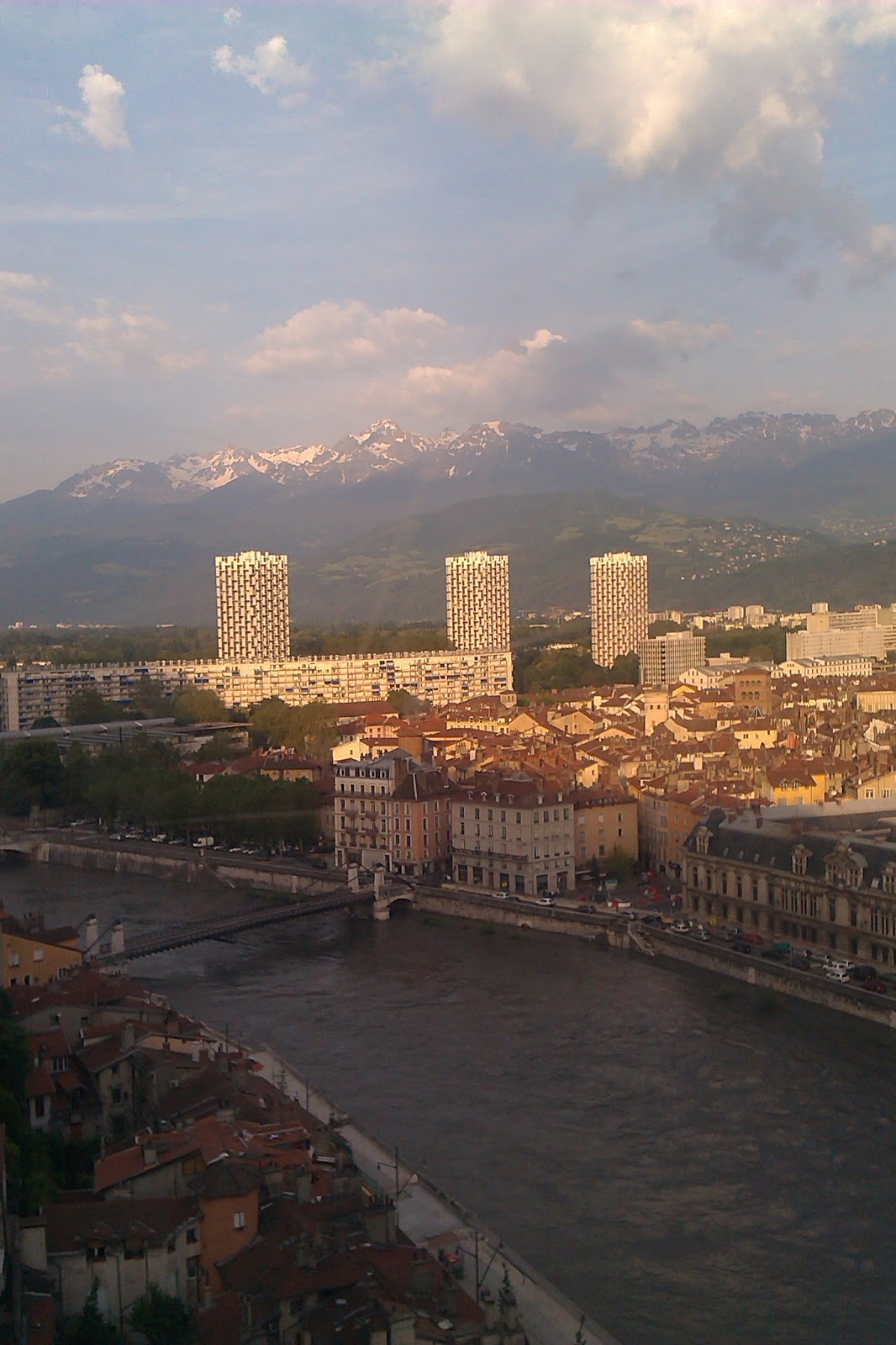
The PowerTech Conference is the main conference of the IEEE Power Engineering Society in Europe. At least this is what we were told in the opening speech on Monday the 17th of June in the World Trade Center of Grenoble. And honestly they really made a lot of effort to leverage the conference impact. Even though the French Minister for research and higher education did not made it personally to the sight still her video message was part of the conference opening session. Executive officers from local transmission and distribution grid operators and electric industries had a slot in that session as well. You might have guessed, by help of the picture, that one of them was from Schneider Electrics which is a quite important player in that region. But there is even more famous things coming from Grenoble: It was the town where Fourier was working and teaching. His house is accessible for public as a museum. Unfortunately I could not find time to visit it as many interesting talks waited to be listened to. 


The representers of industries gave an idea about how their companies deal with the topic Smart Grid. The speakers associated with political institutions gave their perspective about the problems to be solved. It was mentioned several times in this session that there is a big leak of business models for the smart grid. This is associated with missing motivation to invest in technology and its general roll out. Further I was quite surprised to see very familiar content in the slides of the invited speaker M. Masera from the JRC-European Commission. He presented slides related to Ettore Bombard's presentation from last year's Lakeside Labs Research Days about modeling a social layer for smart grid, including user behavior. My own presentation titled “Simulating the Smart Grid” was scheduled to the second day right after the invited speakers in the session about dynamic modeling:

  • M. Poechacker, A. Sobe, and W. Elmenreich. Simulating the smart grid. In Proceedings of IEEE PowerTech, Grenoble, France, 2013.

About seven to eight different tracks were running simultaneously over the 11 sessions, additionally two poster sessions, several invited speakers and special sessions held by companies. Around 500 attendees from all over the world, mainly Europe, have been there. 
 
The main conference program was enriched by technical visits to power system related facilities and the touristic visits in the region. I participated at a tour to the INES (Institute Nacional de Energia Solar), an impressive research center with around 400 employees. The visit has good chance to become content of a further post in this blog. I would say the organizers did a good job. A resume that is strong influenced by the daily served lunch (including the obligatory French chees and wine) and the nice Gala dinner (with life music and artistic presentations) in the ice stadium of Grenoble. 

If I caught your interest in this conference now, the next PowerTech conference will be 2015 in Eindhoven, Netherlands.

Monday, June 17, 2013

Evolutionary Appliance Detection for Miscellaneous Household Appliances

The paper "EvoNILM - Evolutionary Appliance Detection for Miscellaneous Household Appliances" was accepted to the Workshop "Green and Efficient Energy Applications of Genetic and Evolutionary Computation" at Gecco 2013.

To improve the energy awareness of consumers, it is necessary to provide them with information about their energy demand, not just on the household level. Non-intrusive load monitoring (NILM) gives the consumer the opportunity to disaggregate their consumed power on the appliance level. The consumer is provided with information about the energy demand of each individual appliances. In this paper we present an evolutionary optimization algorithm, applicable to NILM purposes. It can be used to detect appliances with a probabilistic power demand model. We show that the detection performance of the evolutionary algorithm can be improved if the single population approach of the evolutionary algorithm is replaced by a parallel population approach with individual exchange and by the introduction of application-oriented pre-processing and mutation methods. The proposed algorithm is tested with Matlab simulations and is evaluated according to the fitness reached and detection probability of the algorithm.

This paper is an improvement and follow up paper of the previous work "Evolving Non-Intrusive Load Monitoring".


Thursday, May 30, 2013

Impressions from e-Energy 2013

On May 22th, 23rd and 24th we attended the fourth International Conference on Future Energy Systems (ACM e-Energy) in Berkeley, California.

The conference was open by the beautiful keynote talk held by Dr. Jeffrey Taft from Cisco. It gave to the audience a complete understanding of current trends in the smart grid.
In their vision, the smart grid is a network combining 4 layers, the energy production and distribution, the market, the information layer and the social network (yes social networks). In the last years the progressive installation of renewable energy generators made the grid more and more unstable, as consequence of the sources exploited. To realize the vision of smart grid, it is necessary to provide the means for applications rather than looking for a killer application that justifies the need of such a change. Indeed innovation in the greed should foster developers, which would create a positive feedback to promote more and more innovation on the system. Basically, the stakeholders are looking for a system that can let them implement closed-loop controllers and attach them to the grid in a plug&play manner. This raises various concerns. The presenter mentioned data interoperability issues in the grid and showed the need of a multilayer network architecture able to tackle the complexity of the system.
In fact there is ongoing research in this direction (e.g. CoAP) but current solutions lack in scalability and still require high degree of mantainability. A multilayer network architecture should be deployed to give stakeholders the possibility to work at different abstraction levels and implement controllers as optimization problems broke down from the overall goal of ensuring a certain degree of reliability and stability.
In this model, the lower levels consist of components exploiting real-time delivery of information to manage safety-critical aspects. In the upper levels, the information is processed (e.g. to produce analytics) and delayed so that decision makers (both human and automatic) can exploit it to optimize specific goal functions.

The other two keynote talks seemed to converge to the need of a distribution network closer to the internet. However, the existing infrastructure will unlikely be replaced with a new smart grid. We will most likely assist to the progressive replacement of crucial components with new ones. This will certainly bring high risk of failure into the system.
On the other hand, developing countries will be able to directly install innovative components into their energy systems, which will let them experiment new technologies and enable them to catch developed countries up. In the third keynote held by Arun Majumdar, the similarities with the internet network are even more evident. He clearly mention the need for something like power routers that would transform a strictly hierarchical network to a more flexible one. Current challenges and trends are very well presented by the speaker, altough for obvious reasons, ongoing solutions studied at Google are not even introduced to the audience.

Sessions:
  1. Storage integration
    The first two papers dealt with the problem of mananging storage so as to reduce peak periods and optimize running costs of devices. The following two were as much interesting, as they proposed the use of batteries to reduce outages and improve power qualities in areas were energy provisioning is particularly unreliable. The third paper was in particular interesting, as it proposed to use a ups on a device-level, so that the ac-dc conversion losses can be minimized for consumer eletronics devices, and the problem of managing storage capabilities can be distributed.
  2. Measurements and their use
    The second session concerned the exploitation of consumption data to infer further information. The first paper presented an approach to demand forecasting, although they only used a feature for their predictor, which definetely makes the solution completely context-less. The second paper proposed a set of requirements and a cloud-based architecture very similar to the one proposed in our paper "Integrating households into the smart grid". However, they used a tailored protocol and data representation and did not consider scalability issues that might arise from this approach. The third paper presented a very interesting approach to infer household and inhabitants characteristics out of metering data. Finally the last paper proposed the use of ethnografy and other kind of studies used in humanities to enrich the data collected through sensor networks, so as to produce much more descriptive representations of inhabitants activities that can be better analyzed during studies promoting energy conservation.
  3. Distributed control
    The third session mostly included papers dealing with distributed vehicle charging.
  4. Data center energy management
    The papers of this session were related to energy-efficient data centres. In particular, the third paper dealt with the efficiency of ethernet interfaces.
  5. Energy efficient networking and network inference
    The first paper presented an approach to infer the topology of the distribution network out of time series collected on meters. The second paper introduced the concept of hierarchical state estimation in the energy grid and reported possible ways of detecting malicious attacks to this system. The following two papers dealt respectively with the performance of network interfaces and the TCP protocol.
  6. Smart homes and buildingsThis session was definetely the last but not the least interesting. In the first paper an implementation of supervised random forest classifier was used to detect the device type connected to a sensing unit, as well as its operational state. In the third paper, a kinect interface was used to determine the amount of clothing weared by people. A voting mechanism was used as comfort feedback for the heating controller of the room. The final goal will be suggesting to the user to wear a coat when he start feeling cold and giving lower rates to the system. The last paper of the session concerned activity recognition in office spaces. In the study they used finite state machines to describe the state logic of the environment. However, this raised an interesting discussion on the need of domain expertise to specify the transitions. Therefore they decided to also use a LHMMs (Layered Hidden Markov Models) and learn the transition probabilities from a dataset. This model is then used to manage the light dimming and status. They showed remarkable savings of energy using this method.
More:
  • Poster and Demo session
    • The poster and demo session was no less interesting than the papers. Among those the work of University of Southampton should be mentioned. Basically, they use a HMM to build a model of inhabitants out of the events created in the household. Beside the HMMs they compared various algorithms, and showed HMM outperforming all of them. In fact it was very interesting to discuss the concept drift issue with classical data stream mining algorithms, as well as to the necessity of binding detected events to the inhabitant who actually performed it in order to improve the model.

  • Panel discussionThe panel discussion was brought up a general discussion and interesting questions summarizing current trends and challenges in:
    • Fossil fuels are not sustainable and we will have to cope with this problem already now, as climate change is evident.
    • Renewable energy are destabilizing the energy grid, due to the volatile sources exploited for the production.
    • Institution will play a crucial role: incentives will have drive customers to more efficient products and technologies, essential role is played by research and development activities.
    • We will move to a situation where users are empowered with energy awareness and their decision making will be enriched by pervasive components, tracking their daily life activities and assisting them in reducing the footprint.
    • Energy will have to flow in a bidirectional way and information regarding energy price will have to be available to users to get them into the loop.

Wednesday, May 22, 2013

Integrating Households into the Smart Grid

On May 20th 2013 we attended the first IEEE Workshop on Modeling and Simulation of Cyber-Physical Energy Systems. The workshop was collocated with the fourth International Conference on Future Energy Systems (ACM e-Energy), to be held in Berkeley on May 22th, 23th and 24rd.


The topics presented were very variegated. In the first session the papers were mostly concerning simulations of building or system-scale aspects in the grid (distribution, market, power flow modeling). The opening presentation was given by Kyle Anderson from Stanford University, presenting the GridSpice simulator, a cloud-based simulation tool which relies on multiple agents to run different existing simulation tools (MATPOWER and GridLab-D) and mantain the overall simulation consistence with a central coordinator. It also provides a RESTful interface to access the simulation, so that it can be integrated in third-part applications.

In the second session more applied and variegated aspects were presented.
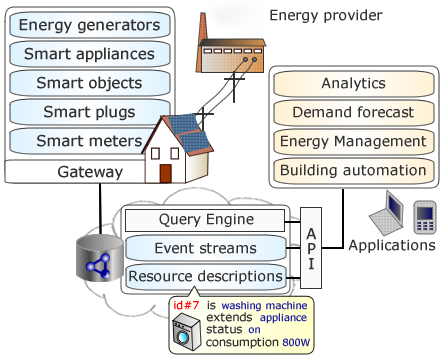
We opened this session with the paper "Integrating Households into the Smart Grid". It deals with the problem of device and data interoperability created by the highly heterogeneous ecosystem of digital devices present in homes. In the paper we discuss requirements that should be addressed when copying with such a complex network. We show that an architecture based on REST webservices and linked data streams would be able to tackle this complexity. Applications can access the data through a uniform interface consisting in specific APIs and standardized query languages, as well as agreed ontologies for the specific use case.

The following presentation surveyed existing ontologies for smart home and smart energy systems and was held by Marco Grassi from Università Politecnica delle Marche. This completed the device and data interoperability issues and gave the audience a complete overview of this side of the smart grid.
The following presentations dealt with security aspects of the grid, such as detecting spoofing attacks on power grid GPS sensors. Also, multi-agent algorithms and control schemes were proposed for various aspects involving cyber-physical energy systems (i.e., resource bargaining, model-predictive control, coordination of power flow controllers).

References:

Monday, May 13, 2013

New Photovoltaic Power Plant

The smart micro grid lab has the major aim to provide the capability to pursue research and to teach students. To meet these requirements the lab is designed to establish a virtual common house with renewable energy sources and the ability to perform energy management tasks.
PV modules on the roof of the
 
Lakeside Science and Technology Park, Klagenfurt, Austria
In detail, the lab finished the first construction phase and is now equipped with a photovoltaic power (PV) plant built up by the company Energetica. The PV has a capacity of 4.8kW and has the ability to act in the grid-connected mode, where energy can be produced, consumed and be fed into the grid and the island-mode, where the lab can be disconnected from the grid and be powered by the PV power plant and a battery buffering systems. To be able to simulate the lab in the grid-connected and the island-mode, the lab has the ability to switch from one mode to the next mode by demand. The concrete technical equipment is based on a Backup System of SMA, which delivers all necessary hardware to switch from island to grid-connected mode and to operate the PV power plant with the PV modules and the batteries.
PV performance over 3 days for cloudy and sunny days
In future, the smart micro grid lab will also be equipped with common household appliances which can be controlled and measured according to the consumed power.  With the ability to store and to generate energy, to connect the lab to and off the grid and to measure and to control appliances, the lab will have the ability to test and to develop algorithms and techniques to improve energy management systems of the future.

Links:
Energetica - energetica Energietechnik GmbH
SMA - SMA Solar Technology AG

Monday, May 6, 2013

The Smart Grid Need

Touching video about the transformation of our energy system into a smart grid:


 "All over the world countries are pursuing grid modernization for the benefits it provides to their environment, their economy and their energy security."

"By modernizing the grid we can squeeze much more power out of the system than we already have and that means saving tens of billions of dollars in power plants and power lines that we do not have to build."