Showing posts with label energy awareness. Show all posts

Friday, December 1, 2023

Energy Disaggregation with NILM on a Raspberry Pi with Smart-Metering Extension

Our recent work on Energy Disaggregation with Non-Intrusive Load Monitoring (NILM) on a Raspberry Pi with a Smart-Metering Extension was presented at the 2nd International Conference on Power Systems and Electrical Technology (PSET) in Milan, Italy, from August 25th to 27, 2023.

Smart Metering Extension for Raspberry Pi
Non-intrusive load monitoring (NILM) is a promising technology for efficient energy feedback in residential settings, supporting low-cost energy management systems. However, achieving accurate disaggregation necessitates higher sampling frequencies than standard smart meters (15-minute intervals). State-of-the-art methods require a minimum frequency of 1Hz, increasing system costs and privacy concerns. To address this, we propose a cost-effective single-device smart meter utilizing Raspberry Pi and YoMoPie Monitor for efficient and accurate local processing of user data.
Our concept involves a low-cost single-device smart meter that provides direct feedback based on local user data processing. The system’s performance was tested in a laboratory setting under two different scenarios, and promising results were obtained.
Our system demonstrated promising results in disaggregation performance and computational complexity in laboratory tests under two scenarios. This study evaluates implementing NILM on an embedded system with limited resources, achieving satisfactory outcomes for five appliances. The open-source software and hardware enable easy replication and further exploration by the research community and other stakeholders.

Color indicating detected devices by the NILM algorithm


 To learn more, check out the paper

Johannes Winkler, Hafsa Bousbiat, Stefan Jost, and Wilfried Elmenreich. Energy Disaggregation with NILM on a Raspberry Pi with Smart-Metering Extension. In Proc. 2023 2nd International Conference on Power Systems and Electrical Technology (PSET 2023), Milan, Italy, August 25-27, 2023.

or visit our NILM Raspberry Pi project on Github.


Tuesday, May 26, 2020

Augmenting an Assisted Living Lab with Non-Intrusive Load Monitoring

The global epidemic of the COVID-19 virus required severe restrictions on travel and meetings. Among many other events, also the International Instrumentation and Measurement Technology Conference (I2MTC 2020) could not take place physically.

Therefore, we made our paper presentation in the form of a video:


In her talk, Hafsa Bousbiat describes how abnormal behavior can be detected among common household devices using Non-Intrusive Load Monitoring. The need for reducing our energy consumption footprint and the increasing number of electric devices in today’s homes is calling for new solutions that allow users to efficiently manage their energy consumption. Real-time feedback at device level would be of significant benefit for this application. In addition, the aging population and their wish to be more autonomous have motivated the use of this same real-time data to indirectly monitor the household’s occupants for their safety.
By breaking down aggregate power consumption into appliance level consumption, Non-Intrusive Load Monitoring allows for reducing the energy consumption footprint and has the potential to indirectly monitor the elderly and help them to fulfil their wish to be more autonomous in a secure manner. Therefore, the work aims to depict an architecture supporting non-intrusive measurement with a smart electricity meter and the handling of these data using an open-source platform that allows us to visualize and process real-time data about the total consumed energy. The proposed architecture is depicted in the figure below.

Proposed architecture for integrating an AAL with an energy monitoring system


More details about our work can be found in the full version of our paper here.

Please reference the paper as follows:
 
Hafsa Bousbiat, Christoph Klemenjak, Gerhard Leitner, and Wilfried Elmenreich. Augmenting an Assisted Living Lab with Non-Intrusive Load Monitoring. International Instrumentation and Measurement Technology Conference. May 2020.

This work was supported by DECIDE - Doctoral school on "Decision-making in a digital environment" at the University of Klagenfurt.

Friday, December 1, 2017

European Workshop on Non-Intrusive Load Monitoring (NILM)

From 6th to 7th of November, the 4th European Workshop on Non-Intrusive Load Monitoring (NILM) was held in London, United Kingdom. This event brought together researchers and professionals to present and discuss latest developments in the area of NILM as well as its applications. 

The sessions comprised topics such as commercial & industrial NILM, innovative algorithms, deep learning approaches, and evaluation. Also, several vendors such as VoltawareQualisteo or Verv introduced their latest products.

In the poster & demo session, Christoph presented a poster on "Appliance Detection in Power Meter Readings". The poster illustrates how correlation can be utilised to detect electrical appliances in power readings. Especially for hardware with limited computational resources this approach shows promising results. For more information about the presented work refer to our paper on correlation filters for appliance detection.

Picture: Christoph Klemenjak (on the left) presenting his poster on appliance detection

A selection of the workshop's talks is available in form of a Youtube playlist.

The next major NILM event will be the International Workshop on Non-Intrusive Load Monitoring, which will take place in late February / early March 2018 in Austin, Texas.

Friday, November 10, 2017

Should I drive with my car to turn off forgotten lights?

I forgot to turn off the lights in my office today. True story. And it's Friday, so unless the cleaning personel turns them off, the lights there will burn unnecessarily for 60 hours until Monday morning. This is a bit embarassing when you are doing research[1] and teaching[2] in sustainability and energy management.
So the question is, should I go there immediately and turn them off? Normally I would use my bike, but it's dark and cold outside so I consider using the car.

Let's crunch the numbers first. My car consumes about 5,5l Diesel per 100 km, so using it for a single person trip is far from contributing to a sustainable future. But the trip will save the energy that would be consumed by the office lights. The trip there and back is 11km, so this would use 0.6 l of Diesel. 1 liter of diesel contains chemical energy worth 9.85 kWh, weighs 835 g, and contains 86% carbon. This 720 g carbon would be mostly burned to CO2, resulting in 2640 g of CO2 [3].

Burning 0,6 l Diesel would thus generate about 1,5 kg of CO2 and waste 5,9 kWh of energy.

What if I let the lights burn? Unfortunately the office lights are not LED-based, but they are fluorescent tubes. I would guess all together the lighting has a power consumption of 100 W. Letting them burn for 60 h would thus waste 6 kWh, basically the same value that we calculated for the used fuel.

About 3/4 of Austria's "Strom-Mix" come from hydropower, wind, waste and solar sources, the remaining part from fossil fuels like gas, oil and coal. I'm lucky that Austria has no nuclear power, first because it is a dangerous technology and second because the effective CO2 emissions of nuclear power are hard to estimate :-).

Coal is the worst source, it comes with 882 g CO2 per kWh[4]. All together Austria's electric energy comes with emissions of 181 g/kWh[5]. So the 6 kWh of electrical energy from the "let's the lights burn" scenario are a bit more than 1kg - less than the scenario where I drive with the car to turn the lights off.

So I should feel bad about the environment, but at least I have my lazyness supported. I might go there by bike tomorrow :-)


Thursday, June 12, 2014

Workshop on Human Centered Energy Management

1st Interdisciplinary Workshop on Human Centered Energy Management
to be held from 7th to 11th of July 2014
at Lakeside Science & Technology Park, Klagenfurt, Austria.

An inter-faculty research field “Energy Management and Energy Technologies”, staffed by academics from a wide range of disciplines, has recently been established at the Alpen-Adria University Klagenfurt (AAU Klagenfurt). Research efforts focus on energy management and energy innovation, networked and de- central energy systems. Together with the Faculty of Technical Sciences (TeWi), the Faculty for Management and Economics (WiWi) and the Faculty of Interdisciplinary Studies (IFF), this new research area will be further developed in cooperation with external partners such as the Lakeside Park.


The Lakeside Park is a platform for cooperation between enterprises and university institutions in the information and communication technology (ICT) sectors. A place of interdisciplinary research and development, training, production and services. The focus of the Lakeside Park is on selected topics of information and communication technology and complementary technologies such as energy systems. In the Interreg IV projects “Smart Energy” and “Efficient, Effective, Smart” the Lakeside Park establishes inter-regional contacts to strengthen collaborative research and development. Therefore, the Lakeside Park and the AAU introduce this novel interdisciplinary workshop with focus on “Human Centered Energy Management”.
Lakeside Park Klagenfurt with a view to the Wörthersee

Human Centered Energy Management

To ensure an efficient production, supply and consumption of energy, it is necessary to introduce novel technologies. Energy monitoring units, new smart control and managing techniques shall improve energy efficiency in the smallest entities of the common power grid – the Smart Building with its inhabitants and its neighborhood. In that respect the individual human being plays a crucial role for energy management tasks. On the one hand it is necessary to improve the energy efficiency of the costumer’s home to reduce energy consumption and costs. On the other hand also the decrease of environmental pollution by optimal utilization of energy resources is a major task of future energy systems.

The proposed workshop “Human Centered Energy Management” takes up these tasks and tries to identify problems and solutions for human centered energy management tasks in an interdisciplinary manner.

Format and Objectives

The aim of the workshop is to give regional experts, such as local professors and young researchers of the AAU, the opportunity to discuss and elaborate ideas with world-wide experts and to introduce and to discuss further ideas in an interdisciplinary setup. Therefore, participants with academic backgrounds and an interest on novel smart energy management systems as well as companies and research institutes are welcome to present and to discuss their research tasks and ideas.

The workshop will have a dedicated “industry day” providing the companies a platform to introduce their problems and to elaborate possible solutions and ideas with experts in the field of energy systems from different disciplines. The general format of the workshop lasts one week with key-speaker inputs and group work with discussions and presentations. Therefore, the event provides an excellent platform for scientific exchange, networking, establishment of international collaboration and the initiation of joint research projects.

Addressed Topics:

  • ICT solutions and approaches for smart home management and systems for integrated energy management.
  • Integration of smart and legacy appliances, renewable energy sources and storage systems in buildings to improve energy efficiency and awareness of inhabitants.
  • Identification, modeling and simulation of energy systems and human behavior
  • Energy data analysis and feedback approaches and behavior influencing information systems
  • Economics and law aspects of human centered energy managements systems in respect to smart homes, smart metering and energy data analysis as well as for renewable energy production and storage systems.
  • Market and business models for ICT-based energy services designed to improve the recent power grid and homes.
For more information about the workshop and how it is possible to participate, please contact dominik.egarter@aau.at.

Monday, November 18, 2013

Impressions from BuildSys 2013

The 5th ACM Workshop On Embedded Systems For Energy-Efficient Buildings (BuildSys) 2013 were hold from the 13th to 14th of November in Rome, where the two researcher Dominik Egarter and Andrea Monacchi participated in. According to the general BuildSys chair the Workshops' aims can be summarized as follows:

The entrance of La Sapienza University, Rome, where SenSys and BuildSys were held
"BuildSys is a venue for discussing new directions in the monitoring, control, and management of energy consumption in buildings, and the generation of awareness and sustainability for an efficient energy market. BuildSys brings together researchers from a multitude of disciplines with a common goal to develop energy saving strategies that can have a major impact worldwide. BuildSys 2013 follows four successful predecessors held in Berkeley, Zurich, Seattle, and Toronto."

This year the workshop had 7 different season such as:
  • Energy Efficiency in Homes,
  • Data Analysis,
  • Occupancy Detection, Monitoring & Use,
  • Sensing for Energy,
  • Energy and Water,
  • HVAC, Modeling and Control and
  • Thermal Comfort Management,
Andrea and Dominik at their posters 
where in total 22 papers were presented. In addition to the general paper presentation, the workshop offers a poster and demo session, where 10 posters and 8 demos were presented. The Smart Grid Group not only visited workshop, Dominik and Andrea were presenting two posters. Dominik showed his current result of Non-Intrusive Load Monitoring (NILM) techniques with the title Appliance State Estimation Based on Particle Filtering. In this paper he showed how it is possible to apply Particle Filtering to the problem of aggregated power loads and how beneficial this approach can be. Moreover, Andreas poster has the title Insert Coin: turning the household into a prepaid billing system and propose an approach for raising energy awareness by combining appliance-level consumption information with prepaid billing so as to turn appliances in pay-as-you-go devices.


D. Egarter, Venkata Pathuri Bhuvana, W. Elmenreich. Appliance State Estimation Based on Particle Filtering5th ACM Workshop on Embedded Systems For Energy-Efficient Buildings, Rome, Italy, 2013.


A. Monacchi, W. Elmenreich. Insert Coin: turning the household into a prepaid billing system,5th ACM Workshop on Embedded Systems For Energy-Efficient Buildings (BuildSys'13), Rome, Italy, 2013


Friday, October 18, 2013

Strategies for domestic energy conservation in Carinthia and Friuli-Venezia Giulia

A recent study carried out by Ernst & Young on the behalf of the German Federal Ministry of Economics analyzed benefits and costs of smart metering in the country and concluded that the savings for the residential customers do not justify the costs. Therefore, a less precipitous replacement of existing meters should be arranged, which would place German utilities in conflict with the EU's target of 80% of consumers equipped with smart meters by 2020.

In the MONERGY project, we aim at providing ICT solutions to promote energy awareness and conservation, in order to lower wastages and costs, and thus CO2 emissions. In particular, we are committed to propose specific strategies considering the peculiarities of two regions under experiment: Carinthia (Austria) and Friuli-Venezia Giulia (Italy). Our initial decision was therefore to conduct an analysis of typical scenarios in the regions, in terms of electrical devices used, availability of smart metering and adaptive tariff plans, exploitation of renewable energy generation. Results of this study are presented in the paper "Strategies for domestic energy conservation in Carinthia and Friuli-Venezia Giulia", which is to be presented next November 12th at the EnergieInformatik conference, in Vienna. Beside spotting similarities and differences in the regions, we also provide a short survey on existing conservation strategies that could be implemented to our purposes.


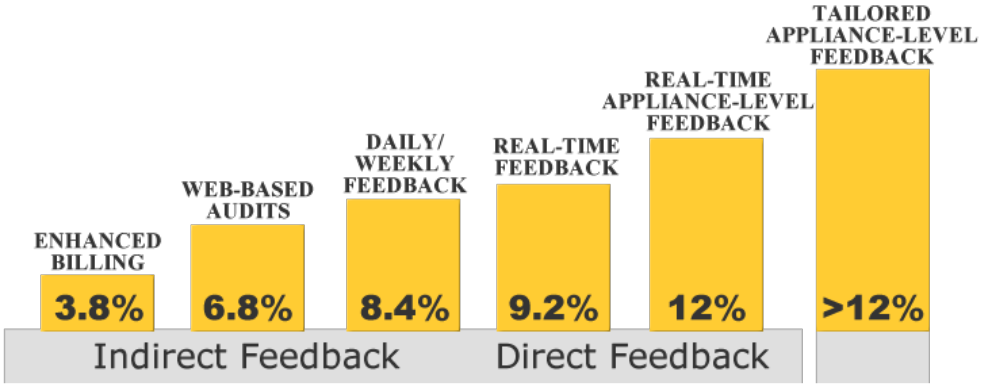
A simple conservation strategy improving energy awareness is prepaid billing. The user can buy a certain amount of energy in advance, and get his credit decreased upon consumption, and until it reaches zero, which causes a disconnection from the grid. This simple mechanism was shown leading to up to 11% of savings for the customers in UK.
From the survey it turned out that the highest savings can be achieved by employing persuasive interfaces, i.e. interactive computing systems displaying enhanced consumption information in order to promote behavioural change. In particular, appliance-level consumption information, both indirect and real-time can boost user's energy awareness, while self-learning mechanisms can be triggered by analytics and recommendations. We therefore decided to implement a prepaid billing system charging individual electrical appliances upon occurrence of consumption events. The system is currently based on the open hardware metering platform called OpenEnergyMonitor. Basically, consumption information is collected down to individual monitored devices by means of current transformers, enhanced with situational information such as time and duration, and sent to a cloud-based web service which manages the user's credit. An Android app was implemented to manage the credit and to provide the user with a smart notification system, which alerts him upon specific events (e.g. credit is over).


We believe that this system can increase the resolution of the consumption feedback and boost energy awareness of users in Carinthia and Friuli, being already applicable in spite of the differences previously spotted. We are currently planning to assess the acceptance of the system and the deriving savings within a case study in actual households in the regions. The strategy will be discussed in the poster session of the next ACM Workshop on Embedded Systems for Energy-Efficient Buildings (BuildSys'13), specifically in "Insert coin: turning the household into a prepaid billing system". We are very much looking forward to getting your comments on our ongoing research. 
In case you are interested in getting further information, an extensive overview of the project is provided by our first deliverable and the project website.
on Embedded Systems for Energy-Efficient Buildings (BuildSys’13) - See more at: http://www.monergy-project.eu/publications/#sthash.7rzhebIn.dpuf