Our publication "Load Hiding of Household's Power Demand" is accepted at the IEEE SmartGridComm 2014. The SmartGridComm 2014 will take place in Venice, a fascinating and marvelous Italian city, on November 3-6, 2014.
Load Hiding of Household's Power Demand, Dominik Egarter, Christoph Prokop, Wilfried Elmenreich
With the development and introduction of smart metering, the energy information for costumers will change from infrequent manual meter readings to fine-grained energy consumption data. On the one hand these fine-grained measurements will lead to an improvement in costumers’ energy habits, but on the other hand the fined-grained data produces in- formation about a household and also households’ inhabitants, which are the basis for many future privacy issues. To ensure household privacy and smart meter information owned by the household inhabitants, load hiding techniques were introduced to obfuscate the load demand visible at the household energy meter. In this work, a state-of-the-art battery- based load hiding (BLH) technique, which uses a controllable battery to disguise the power consumption and a novel load hiding technique called load-based load hiding (LLH) are presented. An LLH system uses an controllable household appliance to obfuscate the household’s power demand. We evaluate and compare both load hiding techniques on real household data and show that both techniques can strengthen household privacy but only LLH can increase appliance level privacy.
Showing posts with label smart home. Show all posts
Showing posts with label smart home. Show all posts
Monday, July 14, 2014


Thursday, June 12, 2014
Workshop on Human Centered Energy Management
1st Interdisciplinary Workshop on Human Centered Energy Management
to be held from 7th to 11th of July 2014
at Lakeside Science & Technology Park, Klagenfurt, Austria.
to be held from 7th to 11th of July 2014
at Lakeside Science & Technology Park, Klagenfurt, Austria.
An inter-faculty research field “Energy Management and Energy Technologies”, staffed by academics from a wide range of disciplines, has recently been established at the Alpen-Adria University Klagenfurt (AAU Klagenfurt). Research efforts focus on energy management and energy innovation, networked and de- central energy systems. Together with the Faculty of Technical Sciences (TeWi), the Faculty for Management and Economics (WiWi) and the Faculty of Interdisciplinary Studies (IFF), this new research area will be further developed in cooperation with external partners such as the Lakeside Park.


The Lakeside Park is a platform for cooperation between enterprises and university institutions in the information and communication technology (ICT) sectors. A place of interdisciplinary research and development, training, production and services. The focus of the Lakeside Park is on selected topics of information and communication technology and complementary technologies such as energy systems. In the Interreg IV projects “Smart Energy” and “Efficient, Effective, Smart” the Lakeside Park establishes inter-regional contacts to strengthen collaborative research and development. Therefore, the Lakeside Park and the AAU introduce this novel interdisciplinary workshop with focus on “Human Centered Energy Management”.
 |
| Lakeside Park Klagenfurt with a view to the Wörthersee |
Human Centered Energy Management
To ensure an efficient production, supply and consumption of energy, it is necessary to introduce novel technologies. Energy monitoring units, new smart control and managing techniques shall improve energy efficiency in the smallest entities of the common power grid – the Smart Building with its inhabitants and its neighborhood. In that respect the individual human being plays a crucial role for energy management tasks. On the one hand it is necessary to improve the energy efficiency of the costumer’s home to reduce energy consumption and costs. On the other hand also the decrease of environmental pollution by optimal utilization of energy resources is a major task of future energy systems.The proposed workshop “Human Centered Energy Management” takes up these tasks and tries to identify problems and solutions for human centered energy management tasks in an interdisciplinary manner.
Format and Objectives
The aim of the workshop is to give regional experts, such as local professors and young researchers of the AAU, the opportunity to discuss and elaborate ideas with world-wide experts and to introduce and to discuss further ideas in an interdisciplinary setup. Therefore, participants with academic backgrounds and an interest on novel smart energy management systems as well as companies and research institutes are welcome to present and to discuss their research tasks and ideas.The workshop will have a dedicated “industry day” providing the companies a platform to introduce their problems and to elaborate possible solutions and ideas with experts in the field of energy systems from different disciplines. The general format of the workshop lasts one week with key-speaker inputs and group work with discussions and presentations. Therefore, the event provides an excellent platform for scientific exchange, networking, establishment of international collaboration and the initiation of joint research projects.
Addressed Topics:
- ICT solutions and approaches for smart home management and systems for integrated energy management.
- Integration of smart and legacy appliances, renewable energy sources and storage systems in buildings to improve energy efficiency and awareness of inhabitants.
- Identification, modeling and simulation of energy systems and human behavior
- Energy data analysis and feedback approaches and behavior influencing information systems
- Economics and law aspects of human centered energy managements systems in respect to smart homes, smart metering and energy data analysis as well as for renewable energy production and storage systems.
- Market and business models for ICT-based energy services designed to improve the recent power grid and homes.
Friday, October 18, 2013
Strategies for domestic energy conservation in Carinthia and Friuli-Venezia Giulia
A recent study carried out by Ernst & Young on the behalf of the German Federal Ministry of Economics analyzed benefits and costs of smart metering in the country and concluded that the savings for the residential customers do not justify the costs. Therefore, a less precipitous replacement of existing meters should be arranged, which would place German utilities in conflict with the EU's target of 80% of consumers equipped with smart meters by 2020.
In the MONERGY project, we aim at providing ICT solutions to promote energy awareness and conservation, in order to lower wastages and costs, and thus CO2 emissions. In particular, we are committed to propose specific strategies considering the peculiarities of two regions under experiment: Carinthia (Austria) and Friuli-Venezia Giulia (Italy). Our initial decision was therefore to conduct an analysis of typical scenarios in the regions, in terms of electrical devices used, availability of smart metering and adaptive tariff plans, exploitation of renewable energy generation. Results of this study are presented in the paper "Strategies for domestic energy conservation in Carinthia and Friuli-Venezia Giulia", which is to be presented next November 12th at the EnergieInformatik conference, in Vienna. Beside spotting similarities and differences in the regions, we also provide a short survey on existing conservation strategies that could be implemented to our purposes.
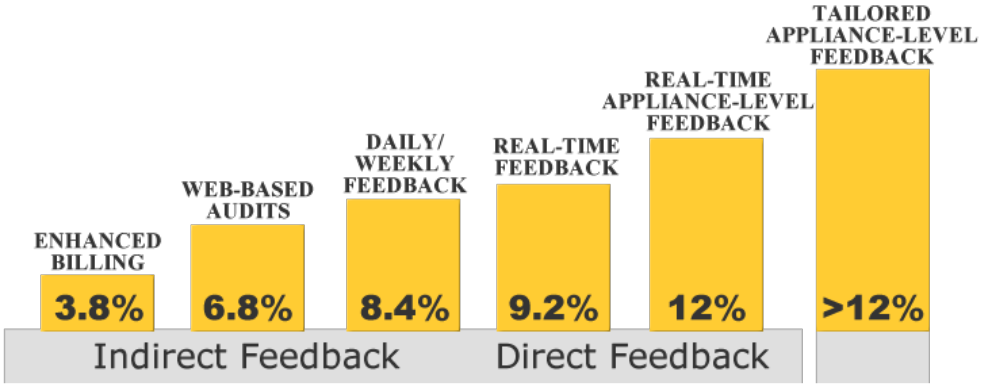
A simple conservation strategy improving energy awareness is prepaid billing. The user can buy a certain amount of energy in advance, and get his credit decreased upon consumption, and until it reaches zero, which causes a disconnection from the grid. This simple mechanism was shown leading to up to 11% of savings for the customers in UK.
From the survey it turned out that the highest savings can be achieved by employing persuasive interfaces, i.e. interactive computing systems displaying enhanced consumption information in order to promote behavioural change. In particular, appliance-level consumption information, both indirect and real-time can boost user's energy awareness, while self-learning mechanisms can be triggered by analytics and recommendations. We therefore decided to implement a prepaid billing system charging individual electrical appliances upon occurrence of consumption events. The system is currently based on the open hardware metering platform called OpenEnergyMonitor. Basically, consumption information is collected down to individual monitored devices by means of current transformers, enhanced with situational information such as time and duration, and sent to a cloud-based web service which manages the user's credit. An Android app was implemented to manage the credit and to provide the user with a smart notification system, which alerts him upon specific events (e.g. credit is over).

|


|
We believe that this system can increase the resolution of the consumption feedback and boost energy awareness of users in Carinthia and Friuli, being already applicable in spite of the differences previously spotted. We are currently planning to assess the acceptance of the system and the deriving savings within a case study in actual households in the regions. The strategy will be discussed in the poster session of the next ACM Workshop on Embedded Systems for Energy-Efficient Buildings (BuildSys'13), specifically in "Insert coin: turning the household into a prepaid billing system". We are very much looking forward to getting your comments on our ongoing research.
In case you are interested in getting further information, an extensive overview of the project is provided by our first deliverable and the project website.
on
Embedded Systems for Energy-Efficient Buildings (BuildSys’13) - See
more at:
http://www.monergy-project.eu/publications/#sthash.7rzhebIn.dpuf
on
Embedded Systems for Energy-Efficient Buildings (BuildSys’13) - See
more at:
http://www.monergy-project.eu/publications/#sthash.7rzhebIn.dpuf
on
Embedded Systems for Energy-Efficient Buildings (BuildSys’13) - See
more at:
http://www.monergy-project.eu/publications/#sthash.7rzhebIn.dpuf
on
Embedded Systems for Energy-Efficient Buildings (BuildSys’13) - See
more at:
http://www.monergy-project.eu/publications/#sthash.7rzhebIn.dpuf
Tuesday, July 30, 2013
Interns@SmartGrid_group
Today we report of a short interview we had with two of our interns, who have been working for one month on developing a web-based home energy management system, consisting in an Android application and a web service.
 What's your name?
Matthias
What are you studying?
I have been studying electronics and technical informatics a the HTL Mössingerstraße in Klagenfurt. This year I finished the 2nd class.
What are your expectations for the future?
After the HTL I want to study software/game development and found a software company.
What your working on?
I worked on two different versions of the same Android app, as well as a REST webservice implemented in PHP.
Basically, I have designed and implemented a MySQL database, and used the php webservice to handle the data and expose the functionalities to the android app I then developed. The apps differ for the JSON protocol used. In fact, only one of these apps is using the php webservice I implemented, the other one is a solution we prepared to mantain retro-compatibility with the old version of the app that was already working for an older project and running on the Google App Engine platform.

Beside calling the REST interface, the apps also implement a smart notification system which exploits the Google Cloud messaging infrastructure to implement push messages from the cloud to the terminals. We use this smart notification system to inform users upon occurrence of certain events of interest.


What did you like of the project?
I like the idea to show the users how much they consume. I think it would be cool if in future energy providers such as Kelag worked with an automatic metering system, so that nobody is required to read the electricity meter for being charged and it is easier to get an understanding of how energy is actually used.
 What's your name?
Alexander
What are you studying?
Electronics and technical informatics at the HTL Mössingerstraße in Klagenfurt.
This year I finished the 4° class, therefore next year I will conclude the HTL.
What are your expectations for the future?
After working for our military I would like to start studying in a similar kind of education or this combined with economics.
What your working on?
During my internship I worked on interactive data visualization. At the beginning I analyzed existing libraries and made a summary of their characteristics before selecting the ones we were looking for. Then, I prepared a graphical interface exploiting the Google Chart and the Chap links chart libraries. The website can do the same things of the Android application.
Basically, the system collects events, such as running a washing machine, which are enhanced by a cost and a duration and shown on a timeline. We can also see the trends for the costs, as users can add money to devices and get an understanding of the cost of carrying out daily life activities.
Currently the data is retrieved from the database using PHP, and all events and payments are shown on the timeline. This raises several issues on performance that I am currently trying to solve using asynchronous calls to the DB, using XMLHttpRequest (i.e., the famous AJAX used in many of the websites we used everyday). I am also investigating ways of keeping the interface up to date, especially concerning the itemization of the energy consumed for the day, using periodically running procedures and/or using triggers on the database.


What did you like of the project?
I had the possibility to work on something I haven’t worked with before. I didn’t have much knowledge on javascript and php but after this month I can say I have programmed a whole website, using advanced tools such as sessions and cookies. I think this was more useful for me than working with programming languages I already know better.
Wednesday, May 22, 2013
Integrating Households into the Smart Grid
On May 20th 2013 we attended the first IEEE Workshop on Modeling and Simulation of Cyber-Physical Energy Systems. The workshop was collocated with the fourth International Conference on Future Energy Systems (ACM e-Energy), to be held in Berkeley on May 22th, 23th and 24rd.

The
topics presented were very variegated. In the first session the papers
were mostly concerning simulations of building or system-scale aspects
in the grid (distribution, market, power flow modeling). The opening
presentation was given by Kyle Anderson from Stanford University,
presenting the GridSpice simulator, a cloud-based simulation tool which
relies on multiple agents to run different existing simulation tools
(MATPOWER and GridLab-D) and mantain the overall simulation consistence
with a central coordinator. It also provides a RESTful interface to
access the simulation, so that it can be integrated in third-part
applications.
In the second session more applied and variegated aspects were presented.
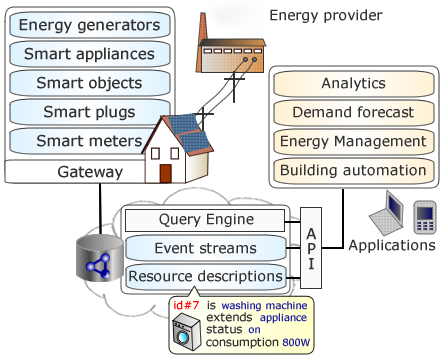
We opened this session with the paper "Integrating Households into the Smart Grid". It deals with the problem of device and data
interoperability created by the highly heterogeneous ecosystem of
digital devices present in homes. In the paper we discuss requirements
that should be addressed when copying with such a complex network. We
show that an architecture based on REST webservices and linked data
streams would be able to tackle this complexity. Applications can access
the data through a uniform interface consisting in specific APIs and
standardized query languages, as well as agreed ontologies for the
specific use case.
The
following presentation surveyed existing ontologies for smart home and
smart energy systems and was held by Marco Grassi from Università
Politecnica delle Marche. This completed the device and data
interoperability issues and gave the audience a complete overview of
this side of the smart grid.
The following presentations dealt
with security aspects of the grid, such as detecting spoofing attacks on
power grid GPS sensors. Also, multi-agent algorithms and control
schemes were proposed for various aspects involving cyber-physical
energy systems (i.e., resource bargaining, model-predictive control,
coordination of power flow controllers).
References:
- A. Monacchi, D. Egarter, W. Elmenreich. Integrating Households into the Smart Grid. Workshop on Modeling and Simulation of Cyber-Physical Energy Systems, Berkeley, CA, May 2013.
Subscribe to:
Posts (Atom)