Showing posts with label simulation. Show all posts

Friday, January 6, 2017

Comparison of the Open Source Smart Grid Simulation Tools RAPSim and GridLAB-D

Renewable Alternative Powersystems Simulation
When you work on smart grid simulations with renewable energy, you most likely have heard about GridLAB-D which is an open source simulator allowing you to combine renewable energy sources with power flow problems in smart grid networks.
The other tool, RAPSim, comes with a similar goal, however was built based on a different design philosophie. While GridLAB-D comes with a textfile-based configuration of your simulation scenario and is run from command line, RAPSim comes with a graphical user interface allowing to generate your scenarios in a Sim City-like interface.
Midhat Jdeed has compared the two tools in his thesis by defining a number of very simple case studies which have been modeled in both tools.
Running GridLAB-D
In the end, he came to the following findings and conclusions: As expected, GridLAB-D comes with a large user base and a a comprehensive library of models. It was more surprising to find out that making a simple model were sometimes more difficult in GridLAB-D. For example, a household with constant load and a PV system could not be well described with the standard elements, because there is no household with a constant load. This makes sense from a realism point of view, but made it difficult to reproduce the same results in different simulators.
As a conclusion, both tools have their merits, be it for the researcher who wants to run simulations online on a simulation server or a teacher that wants to give some students a quick hands on experience with modeling a microgrid with a renewable energy source.

References
M. Jdeed. Comparison of the Smart Grid Simulation Tools RAPSim and GridLAB-D. Master Thesis, Alpen-Adria-Universität Klagenfurt, November 2016.

D. P. Chassin, J. C. Fuller, and N. Djilali. GridLAB-D: An Agent-Based Simulation Framework for Smart Grids. Journal of Applied Mathematics, vol. 2014, Article ID 492320, 12 pages, 2014. doi:10.1155/2014/492320

M. Pöchacker and W. Elmenreich. Model implementation for the extendable open source power system simulator RAPSim. In Proceedings of the 12th International Workshop on Intelligent Solutions in Embedded Systems (WISES'15), pages 103–108, Ancona, Italy, October 2015.

Saturday, November 21, 2015

New Version of Renewables Alternativ Powersystems Simulation (RAPSim) Supports Your Own Model Implementations

We are proud to annouce a new release of our Renewables Alternativ Powersystems Simulation (RAPSim) software. The current version 0.92 is now available on the sourceforge page of RAPsim.

It has been some time since the RAPSim software had been presented at  the IEEE Innovative Smart Grid Technologies Asia and also announced in this blog.

Renewable Alternative Powersystems Simulation
Since then we improved the graphical user interface to allow a smooth interactoin between user and simulation system and improved the software structure to allow for an easy extension of the simulator with your own models. At the 12th Workshop on Intelligent Solutions in Embedded Systems we presented this feature in detail. The main steps are:
  1. Select the correct abstract class and define general attributes. A structure of abstract models is provided to handle all the interaction with the objects and the other simulation parts. The user has to name, describe the model and add an appropriate icon for the model. 
  2. Model parameters must be defined for being available in the GUI. The provided data type deals also with complex numbers. Dependent on the type of implemented model the user can define which variables are editable and visiable. This is also the place to set initial values. 
  3. Define the update procedure. This is the main part of the model implementation, meaning the mathematical part is done here. This includes also the possible allignment of data from an external source, like a file, with the simulation time. 
For details about model implementation please see the paper on this topic which was presented at the WISES 2015:

M. Pöchacker and W. Elmenreich. Model implementation for the extendable open source power system simulator RAPSim. In Proceedings of the 12th International Workshop on Intelligent Solutions in Embedded Systems (WISES'15), pages 103–108, Ancona, Italy, October 2015.

and the RAPSim introduction paper:

M. Pöchacker, T. Khatib, and W. Elmenreich. The microgrid simulation tool RAPSim: Description and case study. In Proceedings of the IEEE Innovative Smart Grid Technologies Asia (ISGT-ASIA'14), Kuala Lumpur, Malaysia, 2014. IEEE.

Tuesday, April 8, 2014

Energiewende - the Game

"Energiewende" is a computer game about the transition of our energy system from fossil fuels to renewable and sustainable energy sources. The game was developed by Manuel Herold, Matija Kucko, Andrea Monacchi, John N. A. Brown, and Wilfried Elmenreich as contribution to the CROSMOS GameJam. At this event teams had to develop a computer game to a topic just revealed at the contest in just two days - 2014 the topic was related to the services of Stadtwerke Klagenfurt. 

Energiewende - the game
The game Energiewende let's you try out the strategic and tactical aspects of an electrical energy system that is mostly powered by renewable energy sources. Unlike a coal power plant, photovoltaic or wind power plants cannot save fuel in times of low load for using it later. Therefore, it is necessary to plan the distribution and placement of power plants well according to the expected power demands of their users - in the game they are modeled as houses with an energy consumption behavior of typical households. After placing power plants and transmission lines, the game features a real-time mode, where your system is simulated throughout three phases of a day (night/morning, daytime, evening). In case there is not enough energy in one phase, you must prevent a blackout (otherwise you loose the game) by balancing the grid. This is done by turning off devices in the houses. But be aware - user might not like this, especially if you turn off a device the user was about to use right now. A "complain-o-meter" is showing the aggregated dislikings of the users - once the complain-o-meter runs over, the game is lost.
Thus, one learns also about the typical consumption of devices and their potential for balancing the grid. The method shown in the game called demand response is currently a frequently discussed method for the future smart grid.

Got everything? Try out the game by clicking the image above. Have fun!

Sunday, December 1, 2013

Open position for an Associate Professor at the Faculty of Electrical Engineering and Information Technology at Vienna University of Technology

The Faculty of Electrical Engineering and Information Technology of Vienna University of Technology invites applications at the Institute of Energy Systems and Electrical Drives for a Tenure track position with qualification agreement for associate professor in the area of Electrical Energy Distribution Systems in form of a initially fixed-term (6 years) tenure track position starting from 01.04.2014. Research areas to be independently covered are automated distribution system operation including information and communication technologies (Smart Grids), integration of renewable and distributed energy resources into the energy system, electro-mobility, Microgrids as well as protection technology. The successful candidate is expected to initiate independent, creative research programs and to establish an own research group.
A strong emphasis is placed on the broad fields of planning, modeling, simulating and analyzing electrical energy distribution systems as well as the integration of decentralized renewable energy resources, hybrid energy storage systems and application of information and communication technologies for automated distribution system operation.
The following requirements for applications to this position exist. The successful candidate is expected to be an internationally recognized scientist with a PhD relevant to the field and perennial experience in one or several of the following research areas:
- Impact of distributed energy resources on distribution system operation and protection
Integration of decentralized renewable energy resources and distributed storage into the energy system
Integration of electro-mobility into the energy system
-
Application of information and communication technology in energy distribution systems
Reliability, resilience and island capability of energy distribution systems
Real time simulation of energy distribution systems and Microgrids
and experience and commitment to excellence in teaching and supervision of undergraduate, graduate and PhD students.

The successful candidate is expected to participate in teaching according to the curricula of the faculty of electrical engineering and information technology and to establish an own research group.
Salaries and benefits of the tenure track position are according to collective labor agreement for employees at universities, salary group B1, based on 40 hours per week, and a monthly minimum salary of currently € 3.411,70 (14 times per year). After signature of the qualification agreement salaries and benefits are raised to salary group A2 and thus monthly € 4.034,70 (14 times per year).
Applications should include curriculum vitae, list of publications, copies of 5 most relevant publications, list of successful grant applications, and list of teaching experience. Applications should be directed to the Dean of the Faculty of Electrical Engineering and Information Technology of Vienna University of Technology, Erzherzog Johann Platz 1, 1040 Wien, Austria. Applications should include a CD-ROM with an electronic version of the complete application documents. Candidate evaluation will begin on 04.01.2014.
Candidates are not eligible for a refund of expenses for travelling and lodging related to the application process.

Monday, June 24, 2013

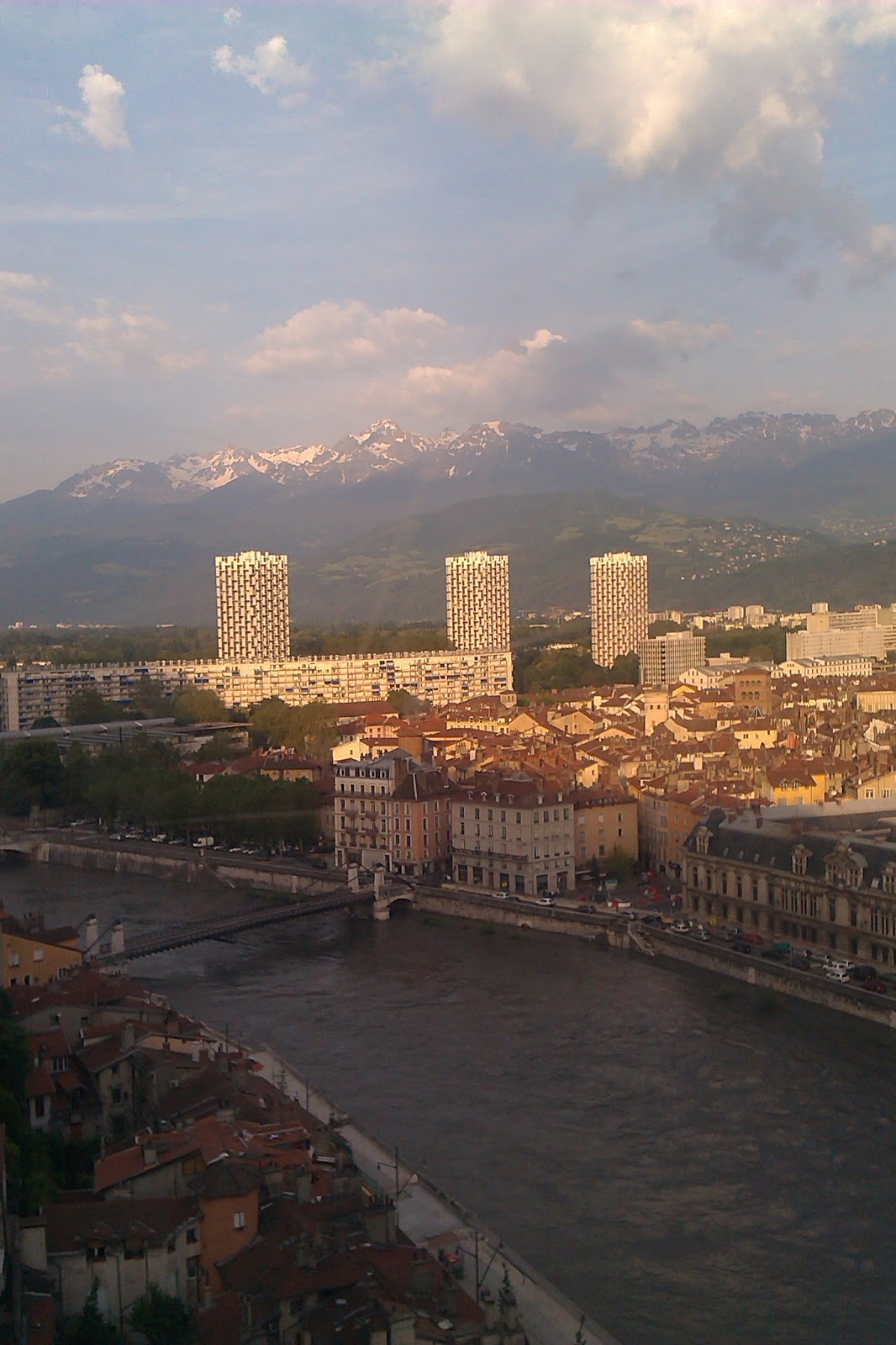
Tales from PowerTech 2013 in Grenoble

The PowerTech Conference is the main conference of the IEEE Power Engineering Society in Europe. At least this is what we were told in the opening speech on Monday the 17th of June in the World Trade Center of Grenoble. And honestly they really made a lot of effort to leverage the conference impact. Even though the French Minister for research and higher education did not made it personally to the sight still her video message was part of the conference opening session. Executive officers from local transmission and distribution grid operators and electric industries had a slot in that session as well. You might have guessed, by help of the picture, that one of them was from Schneider Electrics which is a quite important player in that region. But there is even more famous things coming from Grenoble: It was the town where Fourier was working and teaching. His house is accessible for public as a museum. Unfortunately I could not find time to visit it as many interesting talks waited to be listened to. 


The representers of industries gave an idea about how their companies deal with the topic Smart Grid. The speakers associated with political institutions gave their perspective about the problems to be solved. It was mentioned several times in this session that there is a big leak of business models for the smart grid. This is associated with missing motivation to invest in technology and its general roll out. Further I was quite surprised to see very familiar content in the slides of the invited speaker M. Masera from the JRC-European Commission. He presented slides related to Ettore Bombard's presentation from last year's Lakeside Labs Research Days about modeling a social layer for smart grid, including user behavior. My own presentation titled “Simulating the Smart Grid” was scheduled to the second day right after the invited speakers in the session about dynamic modeling:

  • M. Poechacker, A. Sobe, and W. Elmenreich. Simulating the smart grid. In Proceedings of IEEE PowerTech, Grenoble, France, 2013.

About seven to eight different tracks were running simultaneously over the 11 sessions, additionally two poster sessions, several invited speakers and special sessions held by companies. Around 500 attendees from all over the world, mainly Europe, have been there. 
 
The main conference program was enriched by technical visits to power system related facilities and the touristic visits in the region. I participated at a tour to the INES (Institute Nacional de Energia Solar), an impressive research center with around 400 employees. The visit has good chance to become content of a further post in this blog. I would say the organizers did a good job. A resume that is strong influenced by the daily served lunch (including the obligatory French chees and wine) and the nice Gala dinner (with life music and artistic presentations) in the ice stadium of Grenoble. 

If I caught your interest in this conference now, the next PowerTech conference will be 2015 in Eindhoven, Netherlands.

Tuesday, April 30, 2013

Simulating the Smart Grid

In our PowerTech2013 paper Simulating the Smart Grid we propose a meta-model for a complete view onto the Smart Grid.

Power systems face increased complexitiy because of developments leading to more interdependencies between the power system components. For example:
  • The progress of ICT in the last decades allows new applications in the field of energy.
  • With increasing energy production in small distributed and private plants, the power flow direction is no longer unidirectional, from power plants to endusers. The former consumers becomes a prosumers.
  • Increased use of renewable energies makes the energy production less schedulable. Loads need to be stored or shifted in time. A high need for efficient storage possibilites is generated.
  • The energy market has been liberalized what gives rise to new energy related products and services.
The Smart Grid as Agents operating on several layers of complex flow networks.
 Power systems, as we knew them, are geting smarter by use of ICT. Liberalization of power market is expected to increase efficiency and energy product variety. New developments enable new perspectives which further drive new developments - it is hard, sometimes impossible, to distinguish between the drivers and the outcomes of this process.
The make this highly complex system more comprehensive, we propose to view it as agents operating on different flow networks. The agents optimize their flow according their individual utility function. The rules for the different types of flow are resulting from the subsystem design.
The model is generic but as flows are a measurable quantities it is suitable for quantitative extensions.

M. Pöchacker, A. Sobe, W. Elmenreich: Simulating the Smart Grid, IEEE PowerTech2013, Grenoble, June, 2013.