Showing posts with label distribution. Show all posts

Wednesday, May 22, 2013

Integrating Households into the Smart Grid

On May 20th 2013 we attended the first IEEE Workshop on Modeling and Simulation of Cyber-Physical Energy Systems. The workshop was collocated with the fourth International Conference on Future Energy Systems (ACM e-Energy), to be held in Berkeley on May 22th, 23th and 24rd.


The topics presented were very variegated. In the first session the papers were mostly concerning simulations of building or system-scale aspects in the grid (distribution, market, power flow modeling). The opening presentation was given by Kyle Anderson from Stanford University, presenting the GridSpice simulator, a cloud-based simulation tool which relies on multiple agents to run different existing simulation tools (MATPOWER and GridLab-D) and mantain the overall simulation consistence with a central coordinator. It also provides a RESTful interface to access the simulation, so that it can be integrated in third-part applications.

In the second session more applied and variegated aspects were presented.
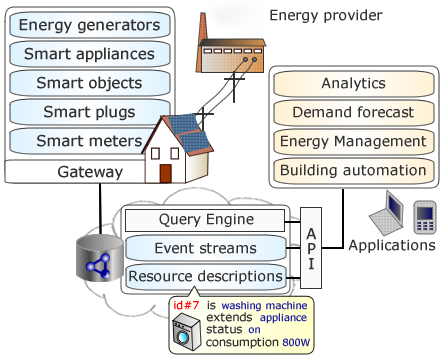
We opened this session with the paper "Integrating Households into the Smart Grid". It deals with the problem of device and data interoperability created by the highly heterogeneous ecosystem of digital devices present in homes. In the paper we discuss requirements that should be addressed when copying with such a complex network. We show that an architecture based on REST webservices and linked data streams would be able to tackle this complexity. Applications can access the data through a uniform interface consisting in specific APIs and standardized query languages, as well as agreed ontologies for the specific use case.
The following presentation surveyed existing ontologies for smart home and smart energy systems and was held by Marco Grassi from Università Politecnica delle Marche. This completed the device and data interoperability issues and gave the audience a complete overview of this side of the smart grid.
The following presentations dealt with security aspects of the grid, such as detecting spoofing attacks on power grid GPS sensors. Also, multi-agent algorithms and control schemes were proposed for various aspects involving cyber-physical energy systems (i.e., resource bargaining, model-predictive control, coordination of power flow controllers).

References:

Tuesday, January 15, 2013

Workshop on Modeling and Simulation of Cyber-Physical Energy Systems 2013

Workshop on Modeling and Simulation of Cyber-Physical Energy Systems 2013
May 20 2013, Berkeley CA

Modern energy systems combine information technology, electrical and thermal infrastructure, autonomous roles and interact with other systems like markets and regulations. Existing modeling and simulation tools are not capable to cover such systems in all of their aspects, new languages, methods and tools are necessary. A combination of universal modeling languages like Modelica and established, specialized tools like grid simulators and telecommunication simulators is necessary. This leads to modeling and co-simulating hybrid systems where for instance a multi-agent framework and an electric grid simulator are combined to investigate smart electric vehicle charging algorithms. It is especially the potential size of such systems that constitute a challenge for modeling and simulation. Implementing these future CPS are another substantial challenge. The designed algorithms need to be compact, computationally inexpensive, potentially self-organizing and intrinsically stable if applied to real energy systems. New methods and alternative ways are necessary to overcome these challenges.

This workshop is a platform for researchers and developers to exchange ideas to the following (not exhaustive) list of topics:

-    Hybrid modeling and simulation
-    Co-Simulation
-    High-performance computing
-    Analytics of system data
-    Ontologies for energy systems
-    Applications of cyber-physical energy systems
-    Distributed algorithms and control
-    Standards in interfacing components
-    Numerics for hybrid and co-simulation
-    Formal languages for energy systems
-    Smart Grid modeling
-    Demand response and power quality
-    Information and communication technology for intelligent energy systems

Submitted papers are peer-reviewed by at least 3 reviewers. Workshop language is English. Proceedings will be published by Springer.
Full paper submission: January 31, 2013
Notification of acceptance: February 20, 2013

Your workshop chairs,
Edward A.Lee (University of California Berkeley)

Monday, September 19, 2011

Siemens smart grid innovation contest winning ideas

In April 2011, Siemens called for an idea contest on Smart Grid Innovation. Now, the four best ideas out of 464 submitted contributions have been announced in an award ceremony in Berlin on September 15th. The winning ideas in short:
Christian Huder from EIT ICT Labs, (Germany) won one of the four prices with his idea
"Smart Grids - comparison or regulatory approaches and their implications on business models" discussing the roles of state, market, and providers.
Slobodan Matic from University of California, Berkeley, (USA) elaborated successfully on the concept of an "Integrated Modular Architecture for Distribution Automation".
If you want acceptance, you need games. Vasilis Nikolopoulos from Intelen, (Greece) explored this topic under the idea of "Advanced Demand Response Behavioral Gamification". Consumers having used to social media and gaming will be happy to play a game of consumption optimization in the future grid.
Multi-agent systems are a promising model for smart grids. Logenthiran Thillainathan from the National University of Singapore introduces the concept as an architectural paradigm for autonomously operating smart grids.

Congratulations to the winners and looking forward to see the ideas soon in action!


Source: Siemens Smart Grid Innovation Contest - Meet the Winners