Showing posts with label smart grid. Show all posts

Wednesday, September 16, 2026

The Austrian Energy Congress Does Not Dance...

...but they are working hard on the architecture of a new European power grid.

More than two centuries ago, in 1814 and 1815, royalty and diplomats gathered in the very same halls of Vienna’s Hofburg and Palais Niederösterreich for the famous Congress of Vienna. Their task was daunting: rebuild European stability and redraw the geopolitical map after years of continental upheaval. History famously quipped that "der Kongress tanzt" (the Congress dances) because of its lavish evening balls, but behind the music, key figures like Metternich and Talleyrand were hammering out systems designed to last for generations.

Fast forward to the Oesterreichs Energie Kongress 2026. The setting remains identical, but the ballroom attire has been swapped for modern engineering precision. Instead of territorial boundaries, today’s delegates are mapping out the politics, responsibilities, resilience, and grid architecture of Europe's energy future. The crisis is no longer post-Napoleonic warfare, but changing geopolitics, climate change, and the mass transition to renewable energy.

Moving Beyond Imperial Ballrooms to Smart Grids

The engineering challenge of our decade mirrors the diplomatic puzzle of 1814: how to build an interconnected, reliable system without causing total collapse under peak stress.

Nowhere is this tension clearer than in transport electrification. Current public and private charging infrastructure can supply less than 44% of the power required for a fully electrified vehicle fleet. To make matters tighter, only about 20% of future battery electric vehicle (BEV) drivers have access to dedicated private parking with personal wallboxes. Most EVs spend their days parked at offices, apartment complexes, and public hubs that lack high-capacity hookups, and traditional grid upgrades are far too slow and expensive to solve the problem in time. For Austria and its neighbors, this is also a question of sovereignty: every kilowatt-hour balanced locally through shared charging and V2G is a kilowatt-hour that doesn't have to be imported, bought at volatile spot-market prices, or routed through congested cross-border lines.

We Are Right There: Presenting Results from Shared Charging

We are on-site at the Hofburg presenting the latest breakthroughs from our Shared Charging initiative, a €9 million project funded by the Climate and Energy Fund and the Austrian Research Promotion Agency (FFG), running from January 2025 through December 2028 under the leadership of go-e GmbH alongside 12 industry and research partners.

Rather than waiting for massive, costly grid overhauls, the Shared Charging ecosystem turns existing constraints into a coordinated advantage:

  • Modular Power Distribution: Smart, semi-public EV charging setups designed to fit directly into current urban workplace and residential infrastructure.
  • Dynamic Energy Balancing: Intelligent algorithms dynamically align charging demand with real-time local supply, soaking up solar generation during sunny hours and wind power during high-wind windows.
  • Bidirectional Charging (V2G): Transforming parked vehicles from passive energy sinks into active storage assets that feed power back into the grid to smooth out peak loads.

Our real-world urban workplace demonstrators prove a crucial point for power systems engineers: preventing grid blackouts in an 80% EV scenario doesn't require tearing up every street in Europe. It simply takes intelligence, coordination, and resource efficiency. . That resilience is measurable: a distributed network of smart chargers and parked EV batteries can absorb local demand spikes or supply drops that would otherwise cascade into brownouts, the same way a diversified alliance system absorbed shocks that a single overstretched empire could not.

While Metternich’s congress waltzed its way toward a 19th-century balance of power, today’s energy community is hard at work balancing megawatt loads. The tunes have changed, but the mission in the Hofburg remains the same: engineering stability for the centuries ahead.

Links:


Tuesday, January 5, 2021

Investigating the impact of data quality on the energy yield forecast using data mining techniques

In this paper, we analysed the impact of using optimum combination of input variables and low dimensional subspace on Photovoltaic (PV) production forecasting accuracy. We worked in collaboration with Prof. Mussetta from Politecnico di Milano.

The main contribution presented in the paper is divided in two parts:
  1. Optimum combination of input meteorological features using feature extraction technique
  2. Low dimensional subspace using dimensional reduction technique
We assess and compare two cases when forecasting models are fed with all the features with the case when low subspace of dataset is used as an input to the models.
The simulation results reveal that depending on the location under study and the regression methods, using less variables as input to the forecasting models are enough to generate nearly similar results without affecting the performance. However, it is necessary to conduct the tests under different climatic conditions so as to ensure the reliability of the results. 
The figures below show the results obtained applying Pearsons correlation and principal component analysis. Figure 1 represents strength of association between two variables. Figure 2 is the biplot representation of the input features contributing variance on principal components PC1 and PC2.

Fig.1 : Pearson correlation map


Fig.2 : Biplot representation 


ISGT Europe 2020 was held virtually and we recorded the presentation for the same. The presentation is available at this link.


To support reproducibility and validating the results we have released the dataset utilized in the work along with the codes. 

Github repository with used dataset and evaluation code

For more information please see the paper:

Ekanki Sharma, Marco Mussetta, and Wilfried Elmenreich. Investigating the impact of data quality on the energy yield forecast using data mining techniques. In Proceedings of the IEEE PES Innovative Smart Grid Technologies Europe (ISGT-Europe). IEEE, October 2020.

Monday, December 2, 2019

Privacy vs. NILM: Obfuscating your Power Consumption with Load Hiding

Load-based load hiding approach
With the development and introduction of smart metering, the energy information from costumers changes from infrequent manual meter readings to fine-grained energy consumption data. On the one hand, these measurements will lead to an improvement in costumers’ energy habits, but on the other hand, the fine-grained data produces information about a household and households’ inhabitants, which give rise to privacy issues because these monitoring results disclose user behavior which could be extracted by smart algorithms and techniques. The loss of privacy by load disaggregation and data mining is a huge upcoming smart grid and social issue which enforces the need for privacy-preserving techniques, which can be divided into the following three possibilities:
  1. Anonymization of metering data: The metering data and customer identity are separated by a third-party id
  2. Privacy-preserving metering data aggregation: Metering data is geographically encapsulated by aggregating the metering data of co-located consumers 
  3. Masking and obfuscation of metering data: Masking the power demand by adding or withdrawing the to the meter visible energy demand with the help of rechargeable batteries or controllable loads.

In the paper

D. Egarter, C. Prokop, and W. Elmenreich. Load hiding of household's power demand. In Proc. IEEE International Conference on Smart Grid Communications (SmartGridComm'14), Venice, Italy, 2014.

a state-of-the-art battery-based load hiding (BLH) technique, which uses a controllable battery to disguise the power consumption and a novel load hiding technique called load-based load hiding (LLH) are presented and compared. A load-based load hiding system controls appliances in a specific way to obfuscate a household’s power demand. For example, an electric water boiler could be instrumented to consume energy in a way that masks the power consumption of smaller household devices like coffee machines or a TV. There is no comfort loss expected for the customer: Overall, the boiler will consume a typical amount of energy and produce the expected amount of hot water.
Using this approach, however, reduces the predictability of your energy consumption, which is good for privacy, but a disadvantage for grid operators.

Wednesday, November 22, 2017

Correlation Filters for Load Classification @ IEEE SmartGridComm

We are happy to announce that our paper "On the Applicability of Correlation Filters for Appliance Detection in Smart Meter Readings" was accepted and presented at this year's SmartGridComm conference in Dresden.

With our load classification approach based on correlation filters, we aim to provide a low-cost non-Intrusive Load Monitoring (NILM) method for measurement equipment with limited computational capabilities such as networked sensors or smart plugs. One of these small devices to run such an algorithm on would be our YoMo metering board.

Abstract:

"Communication systems utilise correlation filters to detect waveforms. In a broader sense, these filters examine the amount of resemblance between a template pattern and the input pattern. In the domain of smart grids, many applications require the detection of active electrical appliances, their condition as well as their current state of operation. Furthermore, the identification of power eaters, the recognition of ageing effects, and the forecast of required maintenance represent important challenges in (home) energy management systems.
In this paper, we examine the applicability of correlation filters as a possible solution to meet such challenges. First, we introduce the concept of predictability to power consumption patterns of electrical appliances. Second, we present our concept and the implementation of correlation filters for this kind of application. The correlation filters utilise a particular consumption pattern of an electrical appliance to detect the respective appliance in energy readings from smart meters and smart plugs.
Lastly, we assess the performance of the correlation filters on the real-world energy consumption dataset GREEND, which provides readings from smart meter data as well as appliance-level measurement equipment. As the results approve, the correlation filters show a good performance for appliances with predictable consumption patterns such as refrigerators, dishwashers, or washing machines. Thus, we propose that future work should evaluate the applicability of correlation filters in appliance diagnosis systems."


Christoph Klemenjak presenting at the load classification session


C. Klemenjak and W. Elmenreich. On the Applicability of Correlation Filters for Appliance Detection in Smart Meter Readings. In Proceedings of the 2017 IEEE International Conference on Smart Grid Communications (SmartGridComm), Dresden, Germany, October 2017.


The Correlation Filters were evaluated on real-world energy consumption data provided by the GREEND dataset, which is available at Sourceforge:

A. Monacchi, D. Egarter, W. Elmenreich, S. D'Alessandro, and A. M. Tonello. GREEND: An energy consumption dataset of households in italy and austria. In Proc. IEEE International Conference on Smart Grid Communications (SmartGridComm'14), Venice, Italy, 2014.


Saturday, November 21, 2015

New Version of Renewables Alternativ Powersystems Simulation (RAPSim) Supports Your Own Model Implementations

We are proud to annouce a new release of our Renewables Alternativ Powersystems Simulation (RAPSim) software. The current version 0.92 is now available on the sourceforge page of RAPsim.

It has been some time since the RAPSim software had been presented at  the IEEE Innovative Smart Grid Technologies Asia and also announced in this blog.

Renewable Alternative Powersystems Simulation
Since then we improved the graphical user interface to allow a smooth interactoin between user and simulation system and improved the software structure to allow for an easy extension of the simulator with your own models. At the 12th Workshop on Intelligent Solutions in Embedded Systems we presented this feature in detail. The main steps are:
  1. Select the correct abstract class and define general attributes. A structure of abstract models is provided to handle all the interaction with the objects and the other simulation parts. The user has to name, describe the model and add an appropriate icon for the model. 
  2. Model parameters must be defined for being available in the GUI. The provided data type deals also with complex numbers. Dependent on the type of implemented model the user can define which variables are editable and visiable. This is also the place to set initial values. 
  3. Define the update procedure. This is the main part of the model implementation, meaning the mathematical part is done here. This includes also the possible allignment of data from an external source, like a file, with the simulation time. 
For details about model implementation please see the paper on this topic which was presented at the WISES 2015:

M. Pöchacker and W. Elmenreich. Model implementation for the extendable open source power system simulator RAPSim. In Proceedings of the 12th International Workshop on Intelligent Solutions in Embedded Systems (WISES'15), pages 103–108, Ancona, Italy, October 2015.

and the RAPSim introduction paper:

M. Pöchacker, T. Khatib, and W. Elmenreich. The microgrid simulation tool RAPSim: Description and case study. In Proceedings of the IEEE Innovative Smart Grid Technologies Asia (ISGT-ASIA'14), Kuala Lumpur, Malaysia, 2014. IEEE.

Monday, September 28, 2015

Interoperability Between Smart and Legacy Devices in Energy Management Systems

Energy management systems can help to decrease energy consumption by giving user feedback or by directly controlling devices. Smart appliances create a network of devices that can be addressed and controlled via a defined network interface. However, legacy devices will establish a significant portion of a system’s power consumption and, therefore, need to be included into the management system. We propose an open architecture to integrate smart and non-smart devices by using smart plugs and non-intrusive load monitoring methods. Devices are connected either as (i) smart appliances via a fieldbus or wireless network, (ii) legacy devices connected to a smart plug, or (iii) other legacy devices being detected from a time sequence of power consumption values, which are disaggregated into the power draws of different devices. At a service layer, device properties are presented in a unified way including a machine-readable description of their features and properties. The data layer provides an abstract representation of data and functionalities. It connects to the application layer where different applications can access the data. The system supports mechanism for service discovery, service coordination, and service and resource description.

Paper:
D. Egarter, A. Monacchi, T. Khatib, and W. Elmenreich. Integration of legacy appliances into home energy management systems. Journal of Ambient Intelligence and Humanized Computing, 2015.

My talk at Workshop Energieinformatik 45. GI-Jahrestagung "Informatik, Energie und Umwelt":

Sunday, April 12, 2015

European NILM workshop 2015 in London


I'm really happy to here that there will be a Second European Workshop on Non-intrusive Load Monitoring this summer.
The event was announced from Oliver Parson, an organizer of the Workshop, as follows:

I'm really excited to announce that the Second European Workshop on Non-intrusive Load Monitoring will be held on 8th July 2015 at Imperial College London. The workshop is the follow up to last year's NILM @ London workshop, which provided the first European venue which brought together both academics and companies with an interest in energy disaggregation. Updates and registration information can be found at the new website: www.nilm.eu

Some important information:

When: 8th July 2015
Where: Imperial College London, UK
Cost: Free
Objective: To provide a European venue for disaggregation researchers to discuss recent developments in the field and fuel future collaborations

This workshop will have a more technical focus than the first workshop, and will feature a keynote from Mario Bergés in the morning and a technical session of invited talks in the afternoon. Furthermore, we're inviting all attendees to bring a poster on a topic of their choice, which could be a recent piece of work, their company's current direction, or even an invitation for collaboration on a joint project. Last, we're hoping to live stream the event online for anyone who can't be there in person, though this is a little experimental!


For more information please visit www.nilm.eu!

Monday, December 1, 2014

Call for Papers Conference on Innovative Smart Grids Technologies Latin American

October 5-6-7, 2015

Hotel Radisson Montevideo, Uruguay

isgtla.org

chairs@isgtla.org


Radisson Montevideo (CC-BY-3.0 Rodrigo uy)
The IEEE PES Conference on Innovative SMART GRID Technologies (ISGT-LA 2015) Latin American, sponsored by the IEEE Power & Energy Society (PES) and hosted by IEEE URUGUAY SECTION and PES local CHAPTER, will be held on OCT 5, 6 and 7th, 2015.

The Conference will be a forum for the participants to discuss state-of-the-art innovations in Smart Grid technologies, to attend tutorials and Industry Panels.

Conference TOPICS are:

- Renewable Energy Sources and Smart Grid (Hydro, Tidal, Wind, Solar and Electric Vehicles, Storage technologies), Wind Integration, Resources forecast (water, wind, weather), Environmental Impacts and Climate change mitigation,

- Energy and Distribution Management Systems, Wide Area Monitoring, Control and Operation (SCADA Systems), Call Center solutions for Smart Grid

- Computational methods and optimization techniques in Smart Grids; Big Data, Massive Grid Data, Data Mining of Smart Grid, Geographic information system (GIS) technology and Smart Grid, Multi-agent Based Applications for Smart Grids

- Smart Grid Impact on Electric Power Systems (Generation, Transmission and Distribution), Grid modeling, analysis and simulation, real time and co-simulation, Stability

- Demand Response, Demand side management, Customer aspects, user behavior and Flexible Demand,

- Smart Grids Information and Communications Technologies (I.C.T): Communications, System Architecture, Operations Support System (OSS), WANs and LANs Networks, 3G/4G networking. Control and Information Systems: Cyber Security Systems, Intelligent Monitoring and Outage Management

- Power System Instrumentation and Measurements, Metering Infrastructure and Instrumentation, Smart Meters, Components Reliability and Diagnostics, System and Components Asset Management

- Power Quality, Energy Efficiency and Smart Grid, Power Electronics Devices: modeling, application, control. FACTS: flexible alternating current transmission system power electronics and Smart Grid

- Protection in Energy Systems, PMUs and Wide Area Monitoring, IEC 61850, distributed IEDs, Synchrophasors in Distribution

- Smart Grids Interoperability, Regulation and Policies, Codes, Standards, Public Policies for implementation of Smart Grids, Testing and certification

-Integration of Distributed Energy Resources, Distributed Generation Islanded Systems and Microgrids: operation, control, monitoring and technologies, Low-voltage direct current (LVDC) distribution networks

- Home and Building Automation, Smart Cities, Cross Energy-domain solutions, Smart Sensors, Convergence of Smart Grid and the Internet of Things,

- Smart Grid Projects, Field Tests, large-scale demonstrations and deployment experiences, Future trends: technologies, researches, standards, incentives, opportunities

- Smart Grid Agenda; Smart Grid Roadmaps, Smart Grid Infrastructure Investments, Planning and Budgets, Cost and Benefits Analysis, Grant Programs,

- Smart Grids and Electricity Markets, Economics and incentive Regulations for Smart Grids, Impact of Smart Grids in Regulation and Energy Pricing, Smart Grids and Sustainable Developement,

- Smart Grid Utility Assets; Smart Grid Assets Management, urban enviroment, self-healing techniques, underground grids, Smart Wires, GIS for Smar Grid,Substation Equipment and Smart Grids; Transformers, Circuit Breakers, Switches

ISGT-LA Sample Papers;

https://drive.google.com/file/d/0B5mRMHjp1zrIa0NiTlVmZDJva0k/view?usp=sharing

Important Dates:

March 15, 2015 EXTENDED ABSTRACT Submission Deadline
June 15, 2015 Notification of paper ACCEPTANCE
August 15, 2015 Camera-ready / FINAL PAPER Submission Deadline
October 5-6-7, 2015 Conference at Radisson Montevideo Hotel


Tuesday, November 4, 2014

Quick intro to the Open Source Renewables Alternative Power System Simulation (RAPSim)

In a previous blogpost, we introduced RAPSim, a free open source power system simulator with a graphical interface. RAPSim was developed at the Alpen-Adria-Universität Klagenfurt within the Lakeside Labs project Smart Microgrid. The main architect of RAPSim, Manfred Rabl-Pöchacker now produced video giving an ultra-fast introduction to the tool. Got three minutes? Here is the video:


Interested? RAPSim can be freely downloaded at rapsim.sourceforge.net.
If you want to learn more about RAPSim, here is a paper about RAPSim:

M. Pöchacker, T. Khatib, and W. Elmenreich. The microgrid simulation tool RAPSim: Description and case study. In Proceedings of the IEEE Innovative Smart Grid Technologies Asia (ISGT-ASIA'14), Kuala Lumpur, Malaysia, 2014. IEEE.

Monday, November 3, 2014

How the Smart Grid will Improve our Live

WhatIsSmartGrid.org blesses us with a happy video about the Smart Grid: "3 Ways the Smart Grid Improves How We Live". Although the video is a bit uncritical on the challenges and implementation costs, the video is interesting and summarizes expected advantages for the customer in a nutshell: By the way, the three things addressed in the video are reliability, cost-savings, and flexibility.

Thursday, August 7, 2014

IEEE SmartGridComm Student Video Competition - Prize $500

We invite students from around the globe to create a short video (duration of max. 3 minutes), presenting their vision or ideas on smart grid technologies, practices and systems. This year we focus on Smart Grid 3.0, the user centric smart grid. We welcome short videos which present original visions and ideas in one of the following categories:
  1. Collaborative Prosumers. Imagine new solutions, business models and applications for collaborative prosumers, the users that produce and consume energy! What solutions can you think for users with rooftop solar panels, local storage from their electric vehicles or battery banks that are all connected in a microgrid or a virtual power plant?
  2. Smart Grid Applications. Imagine a new marketplace of web and mobile applications for the smart grid. This include energy analytics, automation algorithms and demand response, renewable energy forecast, electric vehicles, etc. You can view smart grid as an application development platform.
  3. Electric Vehicles. What is the role of the electric vehicle in new smart grid entities such as microgrids, virtual power plants? How do you imagine vehicle to vehicle (V2V) and/or vehicle to grid (V2G) applications?
Think, imagine, wonder!
  • Think about the smart grid and how it has already been applied
  • Imagine new ideas that will enrich service offerings to utility customers and will engage them
  • Wonder of new techniques that will enhance the participatory role of end users in the network 
Turn your ideas into a video
Create a video of max. 3 minutes long, explaining your views about the smart grid and focus on your personal innovative solution and idea. Be clear, sharp and inspiring! imagine a better world that smarter and cleaner power grids could offer. 
Submission Instructions
  1. Create the video
  2. Upload your video to YouTube
  3. Send to studentscomp14@comsoc.org the following information:
  • ​Your name
  • University affiliation
  • Contact information (mailing address and email)
  • Video title
  • Video link
Selection Process
  1. Approval of video. Videos will be screened by a jury for compliance with the scope of the competition as outlined above.  
  2. Approved videos. The approved videos will be posted on the IEEE SmartGridComm website, where visitors will be able to vote.  
  3. Top 3 videos. The top 3 voted videos will be selected.  
  4. Winning video. The winning video will be decided by the jury, out of the 3 top voted videos. It will be announced on the IEEE website on the date specified and will receive the $500 prize!
Note that only student are eligible to participate. 
Important Dates
  • Video submission deadline: 1 September 2014 10 September 2014
  • Online voting period: 10 September - 17 October 2014
  • Annoucement of top 3 videos: 31 October 2014
  • Annoucement of Top Winner: 5 November 2014 
Video Competition Committee
Dr. George Koutitas, Dept. of Electrical and Computer Engineering, University of Thessaly, Greece
Prof. Stan McClellan, Ingram School of Engineering, Texas State University, USA
Link to Previous Video Competitions
You can see the Video Contests Nominations of previous years at the following links:

Tuesday, July 8, 2014

Call for Papers 1st Workshop on Middleware for a Smarter Use of Electric Energy

CALL FOR PAPERS

MidSEE 2015

1st Workshop on Middleware for a Smarter Use of Electric Energy

in conjunction with NetSys 2015, Cottbus, Germany


MOTIVATION & WORKSHOP SCOPE

Smart energy meters are increasingly installed in newly constructed buildings worldwide, as regulated by, e.g., the European Union's Energy Services Directive. Their combination with the vision of an Internet of Things, in which billions of embedded devices will continually monitor the environment, enables the fine-grained monitoring of household and office energy usage and hence a large range of novel services. While many such functions have been devised so far (e.g., advice how to save energy or the disaggregation of electricity bills), these solutions commonly rely on the availability of hard- and software systems by a single manufacturer. Interoperability, including the potential to integrate new energy metering devices, is mostly unsupported due to the wide variety of (non-compatible) standards and communication protocols.

This workshop provides a platform to present current research activities in communications and processing of energy consumption data, with its primary focus on electric energy usage. The scope of the workshop includes contributions that address the integration of energy metering equipment from different manufacturers into a single middleware system which operates on a building level, as well as novel means to collect, process and visualize these data. Accepted papers will not only present novel research results in these domains, but also comprise an evaluation in which their merits are assessed.

Topics of interest include, but are not limited to:
  • Novel energy metering hardware designs and experiences
  • Data collection and command distribution protocols for energy  management systems
  • Middleware systems for energy data, including novel local data processing algorithms
  • Control of alternative energy sources to increase their production efficiency
  • Innovative tools to model and visualize energy expenditure and production
  • Sensing and actuation of electrical loads
  • Privacy and security in energy management middleware systems
  • User interfaces for energy display, management and control


PAPER SUBMISSION

Authors are invited to submit papers of up to 6 pages in IEEE two-column format. Submissions must be original and should not have been published previously or be under consideration for publication while being evaluated for this workshop. Accepted papers will be published in the IEEE Xplore Digital Library. More details about the ubmission process can be found on the website.


IMPORTANT DATES

Submission:   Sep. 26th, 2014
Notification: Nov. 17th, 2014
Camera Ready: Dec. 10th, 2014
Workshop:     Mar. 12th, 2015


WORKSHOP ORGANIZERS

Andreas Reinhardt, The University of New South Wales, Australia
Christian Renner, Universität zu Lübeck, Germany
Delphine Christin, University of Bonn & Fraunhofer FKIE, Germany


PROGRAM COMMITTEE

Matteo Ceriotti, University of Duisburg-Essen, Germany
Alexander De Luca, LMU München, Germany
Paul Dunphy, Newcastle University, UK
Wilfried Elmenreich, Alpen-Adria-Universität Klagenfurt, Austria
Stefan Fischer, Universität zu Lübeck, Germany
Hannes Frey, University of Koblenz-Landau, Germany
Stefan Katzenbeisser, TU Darmstadt, Germany
Marco Ortolani, University of Palermo, Italy
Oliver Parson, University of Southampton, UK
Daniele Puccinelli, SUPSI, Switzerland
Christian Steger, TU Graz, Austria
Volker Turau, TU Hamburg-Harburg, Germany
Sebastian Zöller, TU Darmstadt, Germany

Thursday, June 12, 2014

Workshop on Human Centered Energy Management

1st Interdisciplinary Workshop on Human Centered Energy Management
to be held from 7th to 11th of July 2014
at Lakeside Science & Technology Park, Klagenfurt, Austria.

An inter-faculty research field “Energy Management and Energy Technologies”, staffed by academics from a wide range of disciplines, has recently been established at the Alpen-Adria University Klagenfurt (AAU Klagenfurt). Research efforts focus on energy management and energy innovation, networked and de- central energy systems. Together with the Faculty of Technical Sciences (TeWi), the Faculty for Management and Economics (WiWi) and the Faculty of Interdisciplinary Studies (IFF), this new research area will be further developed in cooperation with external partners such as the Lakeside Park.


The Lakeside Park is a platform for cooperation between enterprises and university institutions in the information and communication technology (ICT) sectors. A place of interdisciplinary research and development, training, production and services. The focus of the Lakeside Park is on selected topics of information and communication technology and complementary technologies such as energy systems. In the Interreg IV projects “Smart Energy” and “Efficient, Effective, Smart” the Lakeside Park establishes inter-regional contacts to strengthen collaborative research and development. Therefore, the Lakeside Park and the AAU introduce this novel interdisciplinary workshop with focus on “Human Centered Energy Management”.
Lakeside Park Klagenfurt with a view to the Wörthersee

Human Centered Energy Management

To ensure an efficient production, supply and consumption of energy, it is necessary to introduce novel technologies. Energy monitoring units, new smart control and managing techniques shall improve energy efficiency in the smallest entities of the common power grid – the Smart Building with its inhabitants and its neighborhood. In that respect the individual human being plays a crucial role for energy management tasks. On the one hand it is necessary to improve the energy efficiency of the costumer’s home to reduce energy consumption and costs. On the other hand also the decrease of environmental pollution by optimal utilization of energy resources is a major task of future energy systems.

The proposed workshop “Human Centered Energy Management” takes up these tasks and tries to identify problems and solutions for human centered energy management tasks in an interdisciplinary manner.

Format and Objectives

The aim of the workshop is to give regional experts, such as local professors and young researchers of the AAU, the opportunity to discuss and elaborate ideas with world-wide experts and to introduce and to discuss further ideas in an interdisciplinary setup. Therefore, participants with academic backgrounds and an interest on novel smart energy management systems as well as companies and research institutes are welcome to present and to discuss their research tasks and ideas.

The workshop will have a dedicated “industry day” providing the companies a platform to introduce their problems and to elaborate possible solutions and ideas with experts in the field of energy systems from different disciplines. The general format of the workshop lasts one week with key-speaker inputs and group work with discussions and presentations. Therefore, the event provides an excellent platform for scientific exchange, networking, establishment of international collaboration and the initiation of joint research projects.

Addressed Topics:

  • ICT solutions and approaches for smart home management and systems for integrated energy management.
  • Integration of smart and legacy appliances, renewable energy sources and storage systems in buildings to improve energy efficiency and awareness of inhabitants.
  • Identification, modeling and simulation of energy systems and human behavior
  • Energy data analysis and feedback approaches and behavior influencing information systems
  • Economics and law aspects of human centered energy managements systems in respect to smart homes, smart metering and energy data analysis as well as for renewable energy production and storage systems.
  • Market and business models for ICT-based energy services designed to improve the recent power grid and homes.
For more information about the workshop and how it is possible to participate, please contact dominik.egarter@aau.at.

Tuesday, April 8, 2014

Energiewende - the Game

"Energiewende" is a computer game about the transition of our energy system from fossil fuels to renewable and sustainable energy sources. The game was developed by Manuel Herold, Matija Kucko, Andrea Monacchi, John N. A. Brown, and Wilfried Elmenreich as contribution to the CROSMOS GameJam. At this event teams had to develop a computer game to a topic just revealed at the contest in just two days - 2014 the topic was related to the services of Stadtwerke Klagenfurt. 

Energiewende - the game
The game Energiewende let's you try out the strategic and tactical aspects of an electrical energy system that is mostly powered by renewable energy sources. Unlike a coal power plant, photovoltaic or wind power plants cannot save fuel in times of low load for using it later. Therefore, it is necessary to plan the distribution and placement of power plants well according to the expected power demands of their users - in the game they are modeled as houses with an energy consumption behavior of typical households. After placing power plants and transmission lines, the game features a real-time mode, where your system is simulated throughout three phases of a day (night/morning, daytime, evening). In case there is not enough energy in one phase, you must prevent a blackout (otherwise you loose the game) by balancing the grid. This is done by turning off devices in the houses. But be aware - user might not like this, especially if you turn off a device the user was about to use right now. A "complain-o-meter" is showing the aggregated dislikings of the users - once the complain-o-meter runs over, the game is lost.
Thus, one learns also about the typical consumption of devices and their potential for balancing the grid. The method shown in the game called demand response is currently a frequently discussed method for the future smart grid.

Got everything? Try out the game by clicking the image above. Have fun!

Monday, January 20, 2014

Call for Papers IEEE SmartGridComm 2014


============================================================================
CALL for SPECIAL SESSION PROPOSALS: Deadline March 2, 2014
CALL for PAPERS: Deadline April 20, 2014
============================================================================

The IEEE International Conference on Smart Grid Communications (SmartGridComm) 2014 will be held in Venice, Italy, at the Hilton Molino Stucky Hotel on  November 3-6, 2014. The program will include workshops, technical sessions, keynote talks from industrial leaders and renowned academics, panel discussions, and expositions. It will be centered on all aspects of smart grid communications covered by the symposia:

1. Communications and Networks to Enable the Smart Grid
2. Cyber Security and Privacy
3. Architectures, Control and Operation for Smart Grids, Microgrids and Distributed Resources
4. Demand Response and Dynamic Pricing
5. Data Management and Grid Analytics

Thematic Workshops will be held on November 3, 2014.

The program will be completed with a number of social events that will allow the participants to enjoy exclusive networking opportunities and the beauty of the marvelous historical city of Venice.

CALL for SPECIAL SESSION PROPOSALS

The conference will include special sessions on highly specialized topics reporting technical trends and breakthroughs within the scope of IEEE SmartGridComm 2014. Special sessions will be part of each symposium technical program. Special sessions are organized at the initiative of one or more individuals, who must adhere to the procedures published in the Call for Special Sessions.

Important Dates

Deadline for special session proposal: March 2, 2014
Notification of proposal acceptance: March 9, 2014
Submission deadline for special session papers: April 20, 2014
Final notification of session and papers acceptance: July 12, 2014
Camera ready paper submission: August 4, 2014
Author registration: August 4, 2014


CALL for PAPERS

Prospective authors are invited to submit original contributions (standard two column IEEE format, up to six pages) on all aspects of smart grid communications covered by the five conference symposia. Submission guidelines can be found in the Call for Papers.

Important Dates

Paper submission deadline: April 20, 2014
Notification of acceptance: July 12, 2014
Camera ready paper due: August 4, 2014
Author registration deadline: August 4, 2014

Wednesday, December 4, 2013

Wind power or photovoltaics?

Wind power is an interesting option for producing renewable energy. In contrast to Photovoltaics, wind generated energy costs less but it requires transmission infracstructure between wind parks and the consumers.Germany has more than 32 GW of installed wind power capacity and is now building transmission lines to transport the energy to the south.

How predictable is wind in comparison to PV output? The yield of both depend on some meterological factors which are hard to predict. However there is one big difference: you can easily calculate the maximum amount of solar intensity that your PV system has to cope with. With wind speed, it is hard to define a maximum possible wind speed, since on rare occasions wind speed can be significantly higher than the expected value.

Which could be dangerous: If the generator spins faster and faster, large forces produced could cause a wind turbine to self destruct:

Luckily, todays wind turbines have an overspeed control (a braking or featherin mechanism) and a cut-out mode. Still, I don't want them in my garden :-)

Friday, August 16, 2013

Final two Interns@SmartGrid_Group

For the last two months we had further two interns working at our institute. We report a short interview about their work and experiences at our research group.

What's your name?
Julia
What are you studying?
I am studying electrical engineering and industrial electronics at the HTL Mössingerstraße in Klagenfurt and this year I've finished the 4th class.
What are your expectations for the future?
I want to conclude the HTL with good marks, then I would like to study something that combines electrical engineering and economics.
What are you working on?
LabView GUI
I have worked on a LabVIEW measurement program for a photovoltaic system and have also created a consumer box for the lab, where we want to simulate a household. I have installed input modules, which are used for measuring voltage and current, and an output module, which is used for turning the devices on and off. These modules are implemented into my LabView program and further I have created an interface, where the user is able to input data to the program and view power and current consumption. There is also the possibility to read the measured data and control the devices through a web service in the network. I have also installed the hardware elements in the cabinet, created the wiring plan and ordered appliances. The aim of the program is to be used as a control of consumer devices like a refrigerator, water heater and radiator, which are turned on at the time, when the current price is on the lowest peak. Thus this could be an innovative application for saving costs and has to be researched.
Laboratory Installations
What did you like of the project
I liked about my work that I had the chance to contribute my own ideas and expand my programming skills in LabVIEW. It was a very varied project and I liked the mix of manual work and logical thinking.


What's your name?
Johannes
What are you studying?
I'm studying electronics and technical informatics at the HTL Mössingerstraße in Klagenfurt. I have finished my second year.
What are you expectations for the future?
After finishing the HTL, I want to study computer science.
What are you working on?
I was working on Java classes for a Smart Grid Simulator which make it possible to use algorithms from the GridLAB-D simulator. To submit this, I converted all data stored by objects from the Smart Grid Simulator into a file which is then used by GridLAB-D. The output files made by GridLAB-D are read and the values are assigned to the proper object.
OpenEnergyMonitor
GridLAB-D to Smart Grid Simulator 
I was also working on an open source energy monitor made by Openenerymonitor. My task was to enable it to change the refresh rate on the transmitter (emonTX) by using buttons on the receiver (emonGLCD). The difficult thing was to send and receive data at a time using the same transceiver.
Power Profile Generation in Java
My final project was the implementation of a Java program, which generates random power profiles of different appliances out of a given database, place this random profiles randomly in time and finally, tries to detect which appliance was used or not. The technique of appliance detection is called Non-Intrusive Load monitoring and enjoys currently an great interest in research.
What did you like of the project?
I like programming a lot. So I had the opportunity to improve my skills.


Tuesday, July 30, 2013

Interns@SmartGrid_group

Today we report of a short interview we had with two of our interns, who have been working for one month on developing a web-based home energy management system, consisting in an Android application and a web service.


What's your name? 
Matthias

What are you studying?
I have been studying electronics and technical informatics a the HTL Mössingerstraße in Klagenfurt. This year I finished the 2nd class. 

What are your expectations for the future?
After the HTL I want to study software/game development and found a software company.

What your working on?
I worked on two different versions of the same Android app, as well as a REST webservice implemented in PHP.
Basically, I have designed and implemented a MySQL database, and used the php webservice to handle the data and expose the functionalities to the android app I then developed. The apps differ for the JSON protocol used. In fact, only one of these apps is using the php webservice I implemented, the other one is a solution we prepared to mantain retro-compatibility with the old version of the app that was already working for an older project and running on the Google App Engine platform.


Beside calling the REST interface, the apps also implement a smart notification system which exploits the Google Cloud messaging infrastructure to implement push messages from the cloud to the terminals. We use this smart notification system to inform users upon occurrence of certain events of interest.


What did you like of the project?
I like the idea to show the users how much they consume. I think it would be cool if in future energy providers such as Kelag worked with an automatic metering system, so that nobody is required to read the electricity meter for being charged and it is easier to get an understanding of how energy is actually used.


What's your name?
Alexander

What are you studying?
Electronics and technical informatics at the HTL Mössingerstraße in Klagenfurt.
This year I finished the 4° class, therefore next year I will conclude the HTL.

What are your expectations for the future?
After working for our military I would like to start studying in a similar kind of education or this combined with economics.

What your working on?
During my internship I worked on interactive data visualization. At the beginning I analyzed existing libraries and made a summary of their characteristics before selecting the ones we were looking for. Then, I prepared a graphical interface exploiting the Google Chart and the Chap links chart libraries. The website can do the same things of the Android application.
Basically, the system collects events, such as running a washing machine, which are enhanced by a cost and a duration and shown on a timeline. We can also see the trends for the costs, as users can add money to devices and get an understanding of the cost of carrying out daily life activities.
Currently the data is retrieved from the database using PHP, and all events and payments are shown on the timeline. This raises several issues on performance that I am currently trying to solve using asynchronous calls to the DB, using XMLHttpRequest (i.e., the famous AJAX used in many of the websites we used everyday). I am also investigating ways of keeping the interface up to date, especially concerning the itemization of the energy consumed for the day, using periodically running procedures and/or using triggers on the database.


What did you like of the project?
I had the possibility to work on something I haven’t worked with before. I didn’t have much knowledge on javascript and php but after this month I can say I have programmed a whole website, using advanced tools such as sessions and cookies. I think this was more useful for me than working with programming languages I already know better.

Monday, June 24, 2013

Tales from PowerTech 2013 in Grenoble

The PowerTech Conference is the main conference of the IEEE Power Engineering Society in Europe. At least this is what we were told in the opening speech on Monday the 17th of June in the World Trade Center of Grenoble. And honestly they really made a lot of effort to leverage the conference impact. Even though the French Minister for research and higher education did not made it personally to the sight still her video message was part of the conference opening session. Executive officers from local transmission and distribution grid operators and electric industries had a slot in that session as well. You might have guessed, by help of the picture, that one of them was from Schneider Electrics which is a quite important player in that region. But there is even more famous things coming from Grenoble: It was the town where Fourier was working and teaching. His house is accessible for public as a museum. Unfortunately I could not find time to visit it as many interesting talks waited to be listened to. 


The representers of industries gave an idea about how their companies deal with the topic Smart Grid. The speakers associated with political institutions gave their perspective about the problems to be solved. It was mentioned several times in this session that there is a big leak of business models for the smart grid. This is associated with missing motivation to invest in technology and its general roll out. Further I was quite surprised to see very familiar content in the slides of the invited speaker M. Masera from the JRC-European Commission. He presented slides related to Ettore Bombard's presentation from last year's Lakeside Labs Research Days about modeling a social layer for smart grid, including user behavior. My own presentation titled “Simulating the Smart Grid” was scheduled to the second day right after the invited speakers in the session about dynamic modeling:

  • M. Poechacker, A. Sobe, and W. Elmenreich. Simulating the smart grid. In Proceedings of IEEE PowerTech, Grenoble, France, 2013.

About seven to eight different tracks were running simultaneously over the 11 sessions, additionally two poster sessions, several invited speakers and special sessions held by companies. Around 500 attendees from all over the world, mainly Europe, have been there. 
 
The main conference program was enriched by technical visits to power system related facilities and the touristic visits in the region. I participated at a tour to the INES (Institute Nacional de Energia Solar), an impressive research center with around 400 employees. The visit has good chance to become content of a further post in this blog. I would say the organizers did a good job. A resume that is strong influenced by the daily served lunch (including the obligatory French chees and wine) and the nice Gala dinner (with life music and artistic presentations) in the ice stadium of Grenoble. 

If I caught your interest in this conference now, the next PowerTech conference will be 2015 in Eindhoven, Netherlands.

Wednesday, May 22, 2013

Integrating Households into the Smart Grid

On May 20th 2013 we attended the first IEEE Workshop on Modeling and Simulation of Cyber-Physical Energy Systems. The workshop was collocated with the fourth International Conference on Future Energy Systems (ACM e-Energy), to be held in Berkeley on May 22th, 23th and 24rd.


The topics presented were very variegated. In the first session the papers were mostly concerning simulations of building or system-scale aspects in the grid (distribution, market, power flow modeling). The opening presentation was given by Kyle Anderson from Stanford University, presenting the GridSpice simulator, a cloud-based simulation tool which relies on multiple agents to run different existing simulation tools (MATPOWER and GridLab-D) and mantain the overall simulation consistence with a central coordinator. It also provides a RESTful interface to access the simulation, so that it can be integrated in third-part applications.

In the second session more applied and variegated aspects were presented.
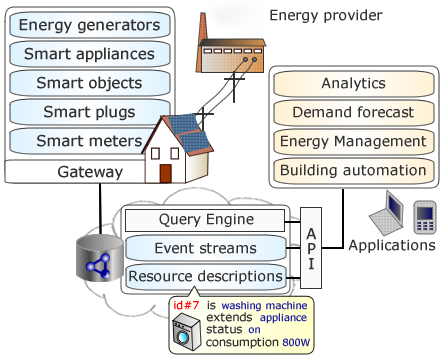
We opened this session with the paper "Integrating Households into the Smart Grid". It deals with the problem of device and data interoperability created by the highly heterogeneous ecosystem of digital devices present in homes. In the paper we discuss requirements that should be addressed when copying with such a complex network. We show that an architecture based on REST webservices and linked data streams would be able to tackle this complexity. Applications can access the data through a uniform interface consisting in specific APIs and standardized query languages, as well as agreed ontologies for the specific use case.

The following presentation surveyed existing ontologies for smart home and smart energy systems and was held by Marco Grassi from Università Politecnica delle Marche. This completed the device and data interoperability issues and gave the audience a complete overview of this side of the smart grid.
The following presentations dealt with security aspects of the grid, such as detecting spoofing attacks on power grid GPS sensors. Also, multi-agent algorithms and control schemes were proposed for various aspects involving cyber-physical energy systems (i.e., resource bargaining, model-predictive control, coordination of power flow controllers).

References: